This stage explores areas on graphs of circular functions. It will draw on your understanding of integration as the reverse of differentiation, and of integration techniques like substitution.
How to Navigate:
Use the arrow keys on your keyboard to move between pages
Use swiping gestures on touch devices
Hover near the bottom of the page to reveal navigation buttons
Look for patterns and remember your circular function identities!
Dr Brian Brooks
Mathematics InSight
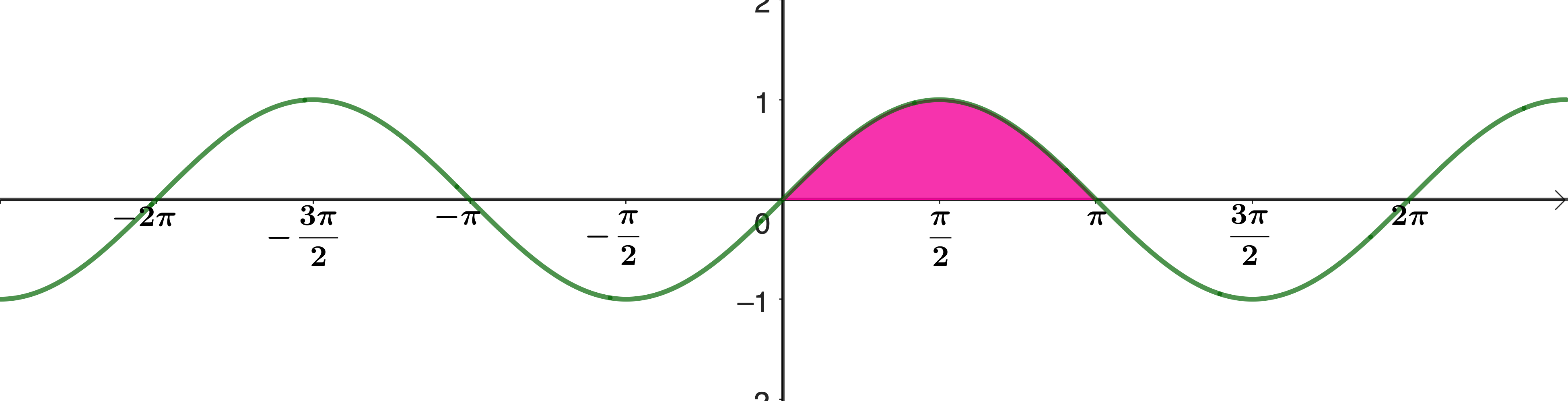
Find the shaded area under the graph \(y=\sin x\).
Please don't let your students use their calculators for any steps such as
putting the integral into the calculator
finding \(\cos 0\) or \(\cos \pi\)
Of course they may be able to do so in an exam, but if they do so now, they will learn nothing.
Since the differential of \(-\cos\) is \(\sin\), and since integration is the opposite of differentiation, it must be the case that the integral of sin is \(−\cos\). This means that
\[\begin{aligned}\text{area} &= \int_0^\pi \sin x \, \mathrm{d}x\end{aligned}\]
Before we try to integrate \(\tan x\), find \(\dfrac{\mathrm{d}}{\mathrm{d}x} \ln|\cos x|\)
Integrating \(\tan x\) needs integration by substitution, with which your students may not yet be familiar. However, they will surely know the chain rule, so if necessary, this page will provide a fix for this.
For the integral of tan, either use the result on the previous page, or use the substitution \(u = \cos x\). Or they might remember the rule for \(\int \frac{f'}{f}\), but even so, it's a good idea to do the substitution to remind themselves why this rule works.
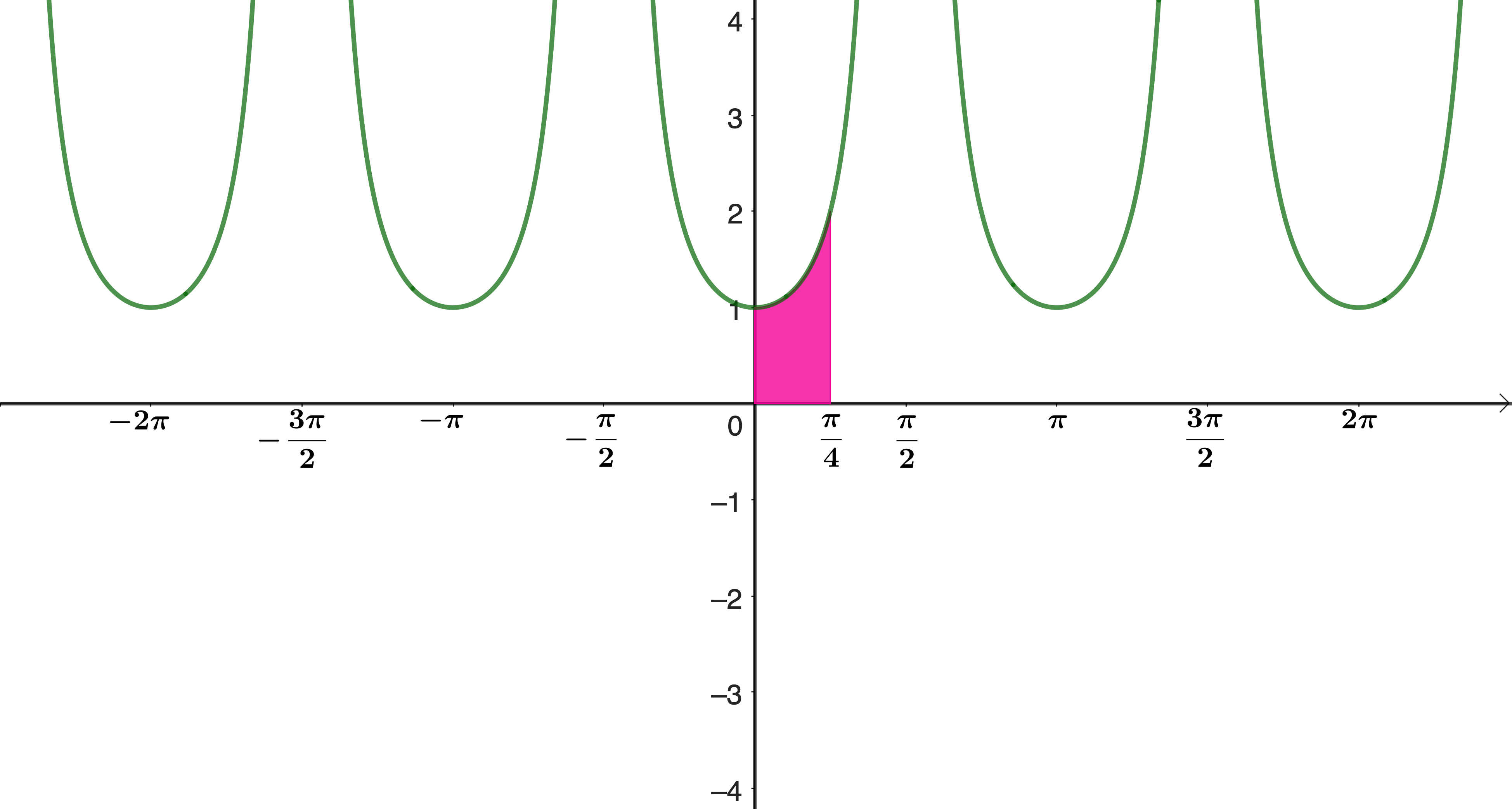
Often, students will get the final version from the formula book without noticing that \(-\ln|\cos x|\) and \(\ln|\sec x|\) are the same thing, so it's a good moment to emphasise this.
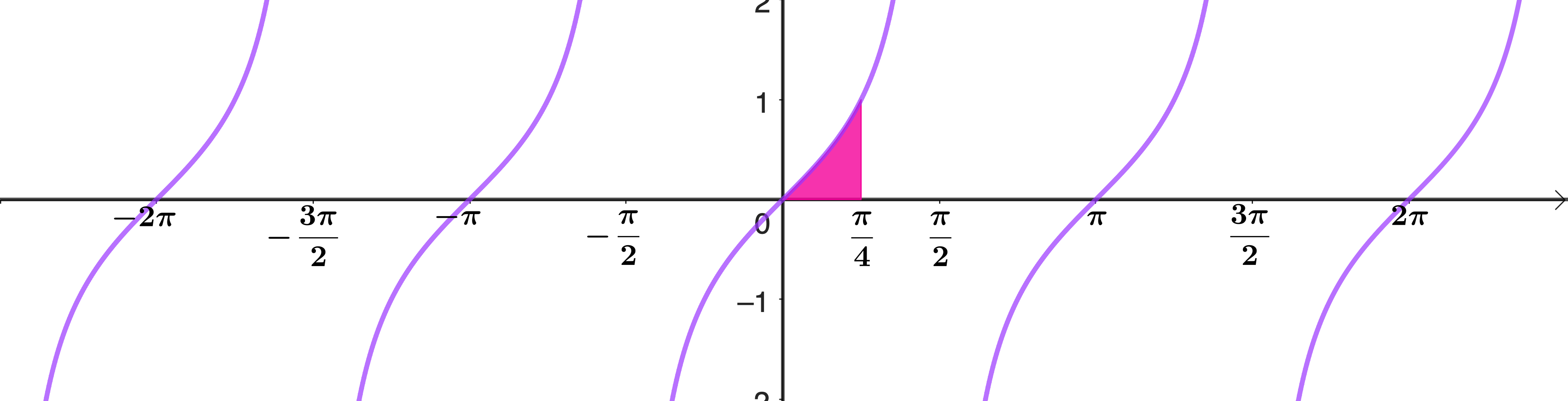
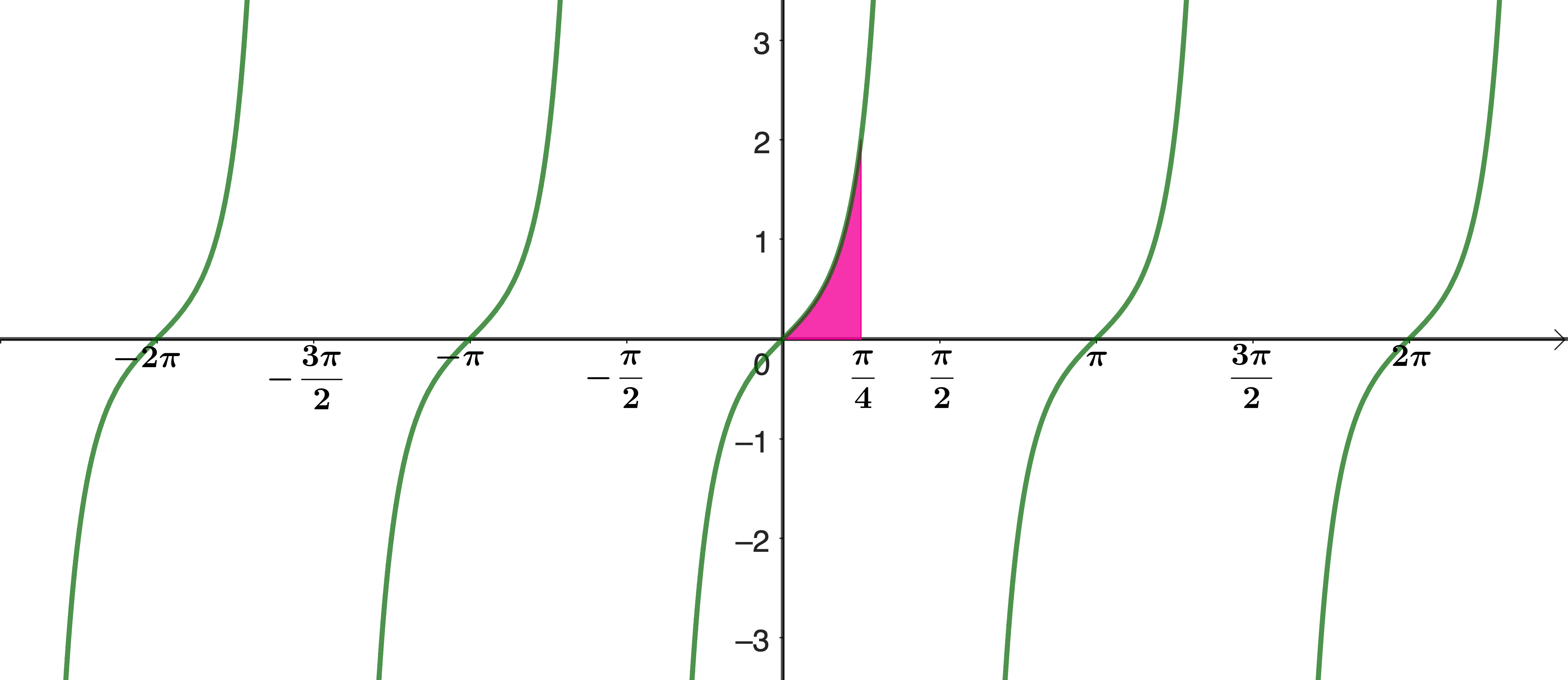
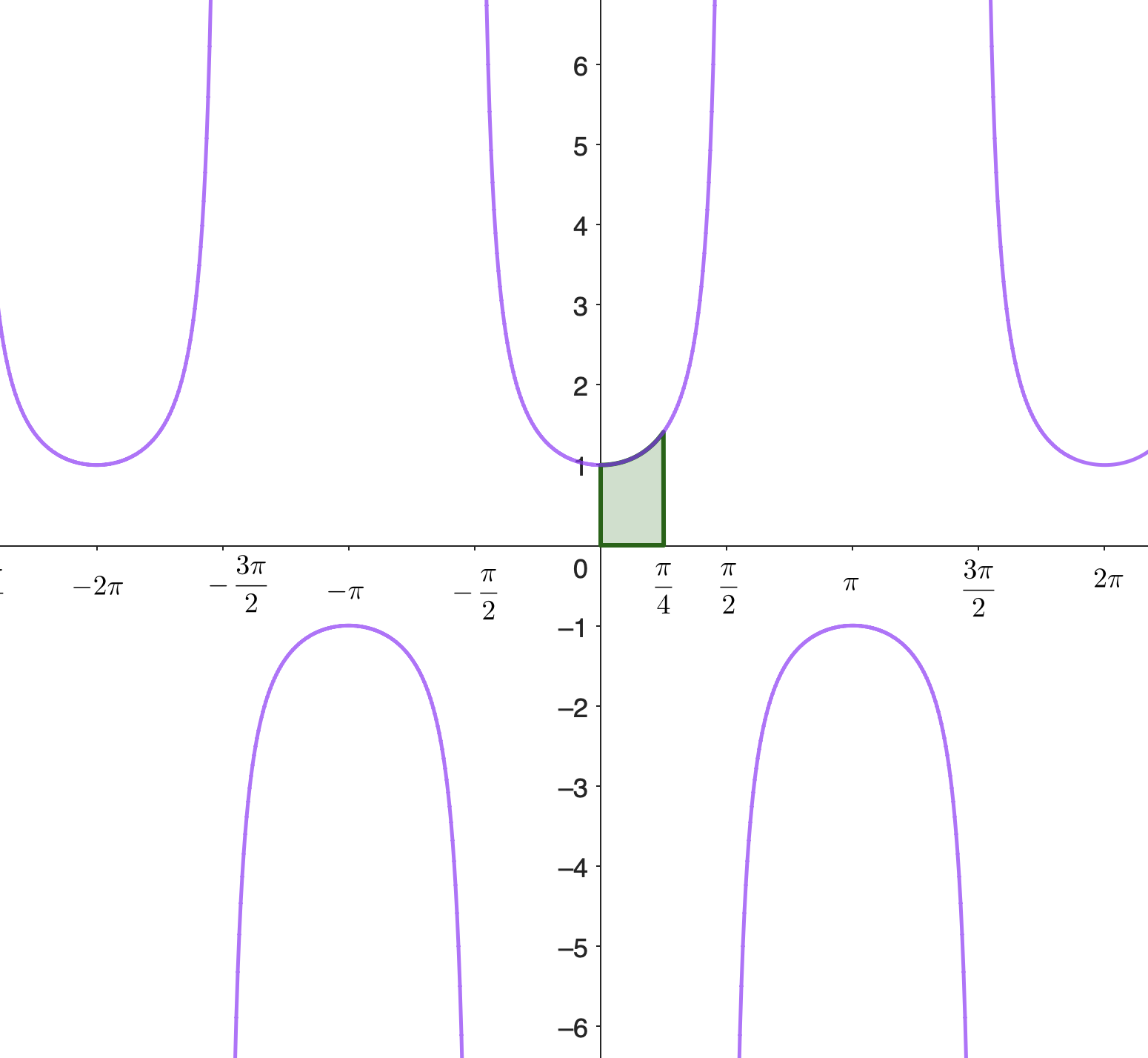
Using the result \(\displaystyle{\frac{\mathrm{d}\ln|\cos x|}{\mathrm{d}x}= -\tan x}\), find the shaded area under the graph \(y=\tan x\).
\[\int \tan x \, \mathrm{d}x=-\ln|\cos x|=\ln\left|(\cos x)^{-1}\right|=\ln|\sec x|\]
For the area, we can use either form of the integral of tan, but please, no calculators, even for the manipulation of logs.
\[\begin{aligned}\text{area} &= \int_0^{\frac{\pi}{4}} \tan x \, \mathrm{d}x\end{aligned}\]
Here is the most straightforward method, but even once they have seen this idea and used it a few times, students often need reminding to use a double angle formula for \(\cos 2x\) to integrate \(\sin^2 x\) or \(\cos^2 x\).
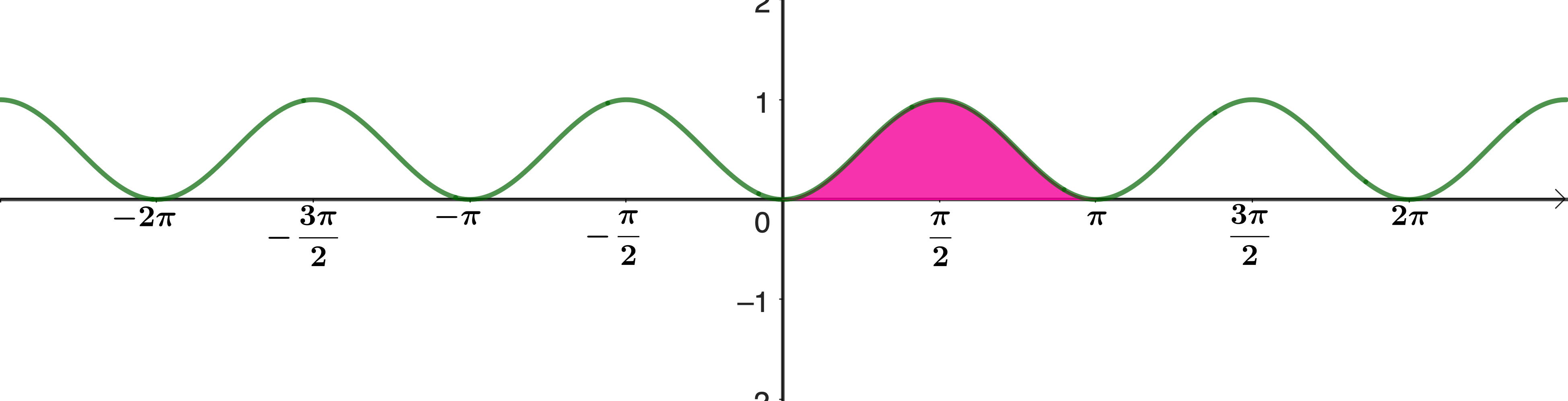
Find the shaded area under the graph \(y = \sin^2 x\).
Compare your answer with \(\displaystyle\int_0^\pi \sin x \, \mathrm{d}x\). Which is bigger? Explain your answer in terms of the graphs.
Probably the easiest method is to rearrange one of the formulas for \(\cos 2x\):
\[\begin{aligned}\text{area} &= \int_0^\pi \sin^2 x \, \mathrm{d}x\end{aligned}\]
\[\int_0^\pi \sin^2 x \, \mathrm{d}x=\frac{\pi}{2} < 2=\int_0^\pi \sin x \, \mathrm{d}x\]
When \(0 < x < \pi,\quad 0 < \sin x < 1 \quad \Rightarrow \sin^2 x < \sin x\),
so the area on the \(\sin^2\) graph must be less than the area on the \(\sin\) graph.
You might be tempted to integrate by parts if you are familiar with this technique. If so, don't let me stop you! But the first method is surely easier. Here is the "by parts" method in case you are interested:
\[u = \sin x \quad \frac{\mathrm{d}v}{\mathrm{d}x} = \sin x\]
\[\frac{\mathrm{d}u}{\mathrm{d}x} = \cos x \quad v = -\cos x\]
\[\begin{aligned}\phantom{\Rightarrow 2{}}\int \sin^2 x \, \mathrm{d}x &= -\sin x \cos x + \int \cos x \cos x \, \mathrm{d}x\end{aligned}\]
\[\begin{aligned}\phantom{\Rightarrow 2\int \sin^2 x \, \mathrm{d}x} &= -\frac{1}{2}\sin 2x + \int \cos^2 x \, \mathrm{d}x\end{aligned}\]
\[\begin{aligned}\phantom{\Rightarrow 2\int \sin^2 x \, \mathrm{d}x} &= -\frac{1}{2}\sin 2x + \int 1 - \sin^2 x \, \mathrm{d}x\end{aligned}\]
\[\begin{aligned}\phantom{\Rightarrow 2\int \sin^2 x \, \mathrm{d}x} &= -\frac{1}{2}\sin 2x + x - \int \sin^2 x \, \mathrm{d}x\end{aligned}\]
\[\begin{aligned}\Rightarrow 2\int \sin^2 x \, \mathrm{d}x &= x - \frac{1}{2}\sin 2x+c\end{aligned}\]
This kind of "integrating by looking" is always something to be on the alert for.
Alternatively, there is always substitution:
\[u = \cos x \Rightarrow \frac{\mathrm{d}u}{\mathrm{d}x} = -\sin x\]
\[\begin{aligned}\int_0^{\frac{\pi}{2}} \sin x \cos^2 x \, \mathrm{d}x &= \int_1^0 \sin x \cos^2 x \frac{\mathrm{d}x}{\mathrm{d}u} \, \mathrm{d}u\end{aligned}\]
\[\begin{aligned}\phantom{\int_0^{\frac{\pi}{2}} \sin x \cos^2 x \, \mathrm{d}x} &= -\int_1^0 \frac{u^2 \sin x}{\sin x} \, \mathrm{d}u\end{aligned}\]
\[\begin{aligned}\phantom{\int_0^{\frac{\pi}{2}} \sin x \cos^2 x \, \mathrm{d}x} &= \int_0^1 u^2 \, \mathrm{d}u = \Bigg[\frac{u^3}{3}\Bigg]_0^1\end{aligned}\]
\[\begin{aligned}\phantom{\int_0^{\frac{\pi}{2}} \sin x \cos^2 x \, \mathrm{d}x} &= \frac{1}{3}\end{aligned}\]
Did you notice the change of order of the limits toward the end to deal with the minus sign before the integral?
Here, I've used two results from earlier in the sheet (but doubled one of them)
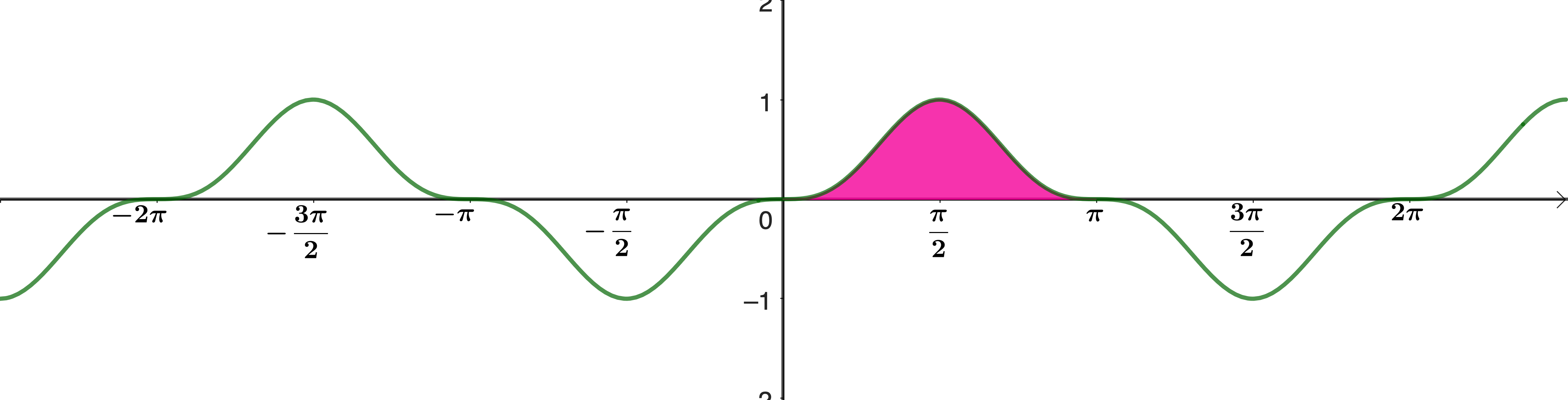
Find the shaded area under the graph \(y = \sin^3 x\).
Again, this one is easier than it looks, and it uses two previous results.
\[\begin{aligned}\int_0^\pi \sin^3 x \, \mathrm{d}x &= \int_0^\pi \sin x (1 - \cos^2 x) \, \mathrm{d}x\end{aligned}\]
\[\begin{aligned}\phantom{\int_0^\pi \sin^3 x \, \mathrm{d}x} &= \int_0^\pi \sin x - \sin x \cos^2 x \, \mathrm{d}x\end{aligned}\]
\[\begin{aligned}\phantom{\int_0^\pi \sin^3 x \, \mathrm{d}x} &= 2 - \frac{2}{3}\end{aligned}\]
\[\begin{aligned}\phantom{\int_0^\pi \sin^3 x \, \mathrm{d}x} &= \frac{4}{3}\end{aligned}\]
When \(0 < x < \pi\),
\[0 < \sin x < 1 \quad \Rightarrow \sin^3 x < \sin^2 x < \sin x\] which explains why
\[\int_0^\pi \sin^3 x \, \mathrm{d}x < \int_0^\pi \sin^2 x \, \mathrm{d}x < \int_0^\pi \sin x \, \mathrm{d}x\]
\[\frac{\mathrm{d}}{\mathrm{d}x}\cos^{-2} x = 2\cos^{-3} x \sin x\]
Here's another crazy looking example that, surprisingly, you can do just by looking at it!
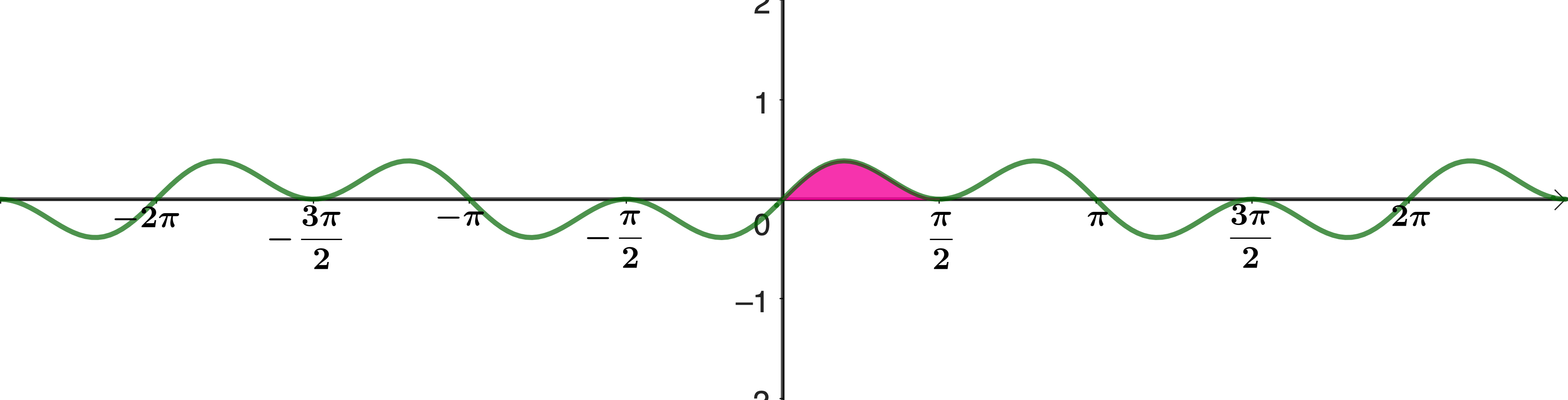
Find the shaded area under the graph \(\displaystyle{y = \frac{\sin x}{\cos^3 x}}\).
Notice, though, that \(\sec^2 x = 1 + \tan^2 x\), so \[\int \frac{\sin x}{\cos^3 x} \, \mathrm{d}x = \frac{\tan^2 x}{2} + c'\]
If you like your substitutions, there are at least three substitutions that will give us three more methods for the same integral:
\[u = \cos x \qquad u = \sec x \qquad u = \tan x\]
Give them a go if you feel like it.
Here's one:
There are at least three more substitutions that will give us three more methods for the same integral to find the shaded area under the graph \(\displaystyle{y = \frac{\sin x}{\cos^3 x}}\).
\[u = \cos x \quad u=\sec x\quad \text{or}\quad u=\tan x\]
\[u = \cos x \quad \frac{\mathrm{d}u}{\mathrm{d}x} = -\sin x\]
There are a number of substitutions that will work.
First, the standard substitution method; this suffers from the fact that it more or less relies on your knowing the answer in advance.
You now have two versions of the integral that look very different.
Show that \( \displaystyle{\ln\left|\frac{1 + \sin x}{\cos x}\right| + c}\) and \(\displaystyle{\frac{1}{2}\ln\left|\frac{1 + \sin x}{1 - \sin x}\right| + c}\) are equivalent versions of \(\displaystyle{\int \sec x \, \mathrm{d}x }\)
Congratulations on completing your circular functions journey!
At this point, your understanding of circular functions, their graphs, differentials, and integrals is strong. With this foundation, you are extremely well positioned to apply your skills to the solution of problems that you encounter in both mathematics and physics.
What's Next:
The next stage focuses on inverse circular functions
You already know how to find angles in right-angled triangles, and this stage explores how to extend this understanding to the far more general circular functions.
Integration is a powerful tool—keep looking for patterns and connections between different methods!
 Dr Brian Brooks