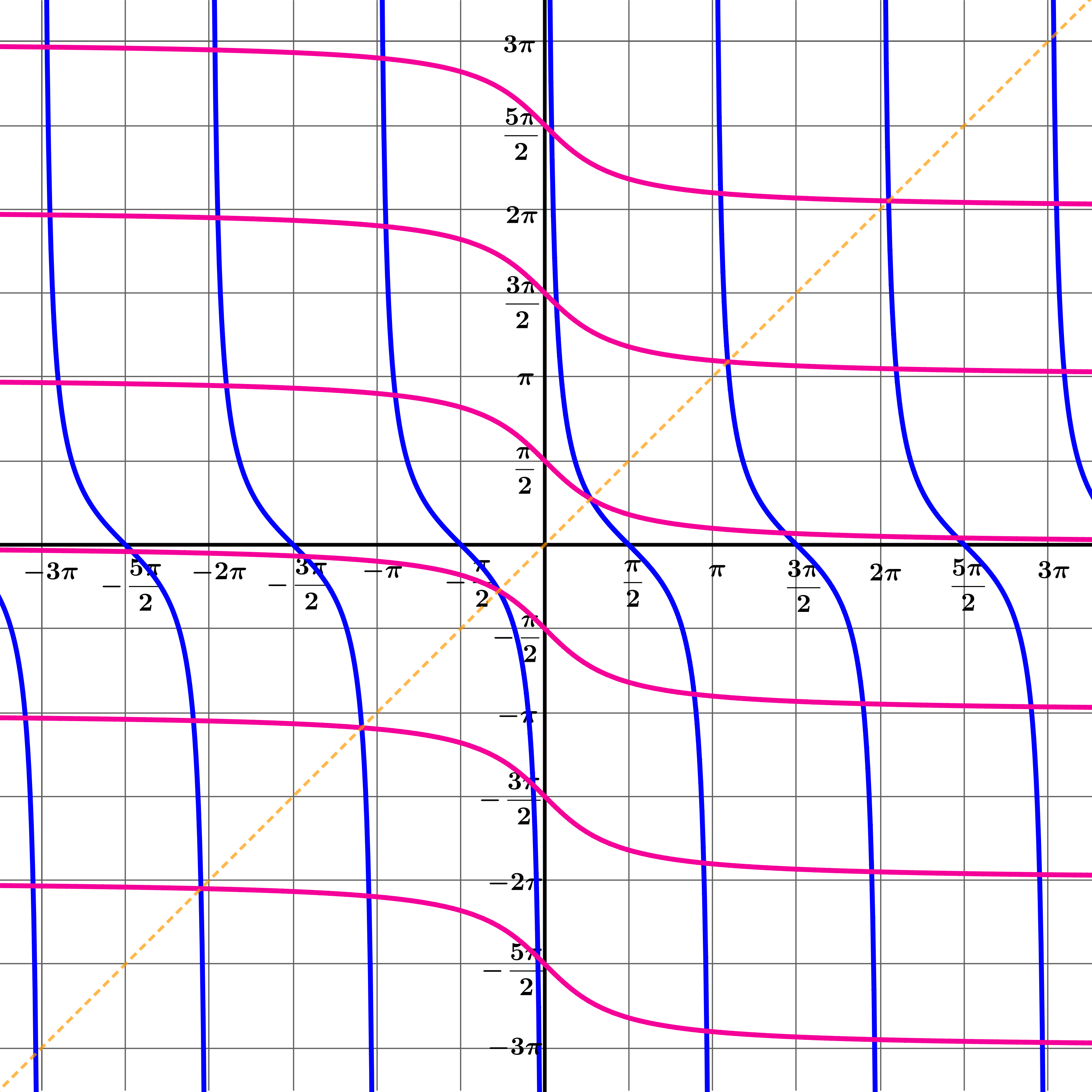
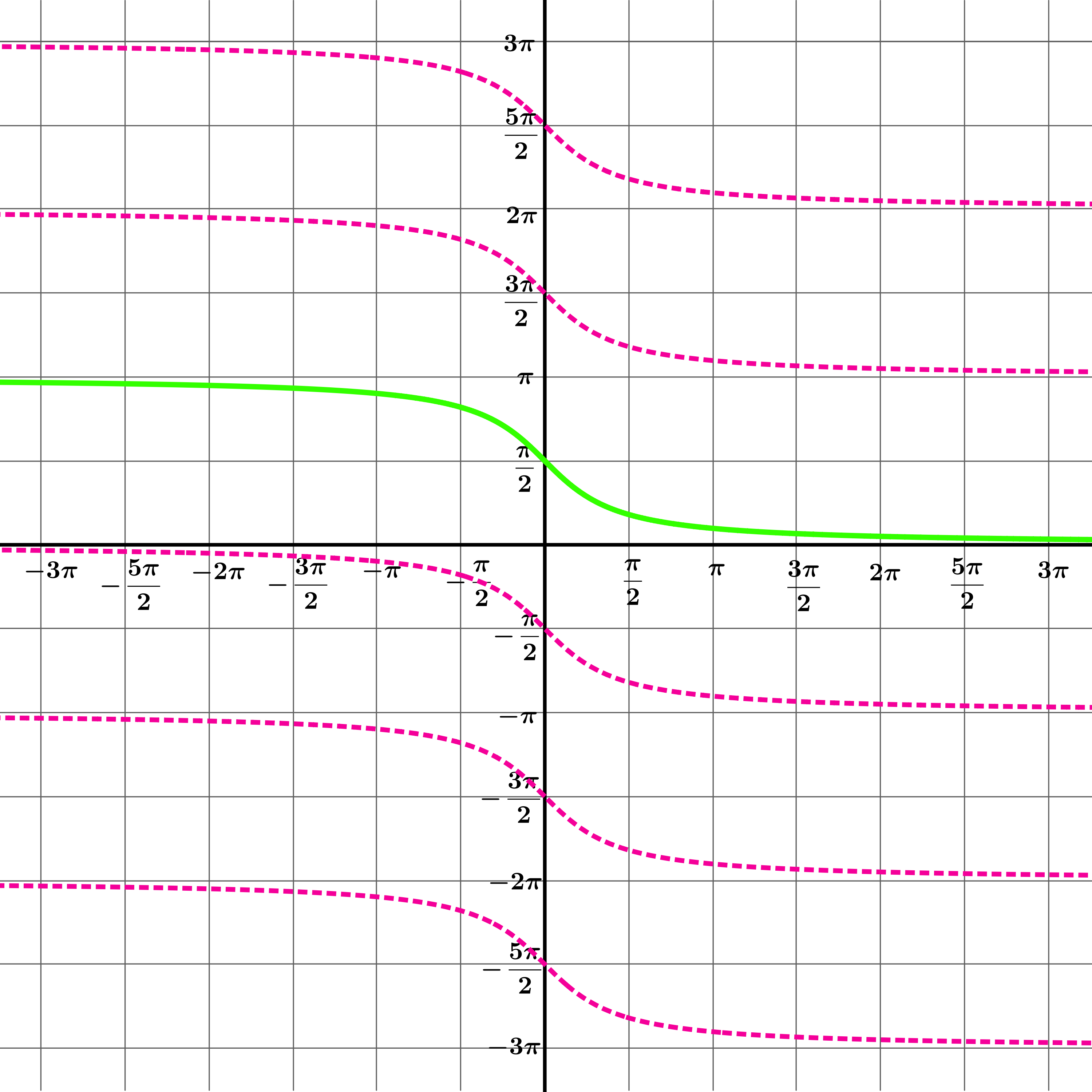
We've worked through the basic circular functions: sin, cos, and tan. We've worked through the reciprocal circular functions: cosec, sec, and cot. We've worked on the inverses of the basic functions: arcsin, arccos, and arctan. Surely that's plenty? Yes it is, especially when we've worked through them all in such depth. But if you are still just a little bit interested to see more, we could work on the inverses of the reciprocal functions: arccosec, arcsec, arccot. Strictly for interest only, though!
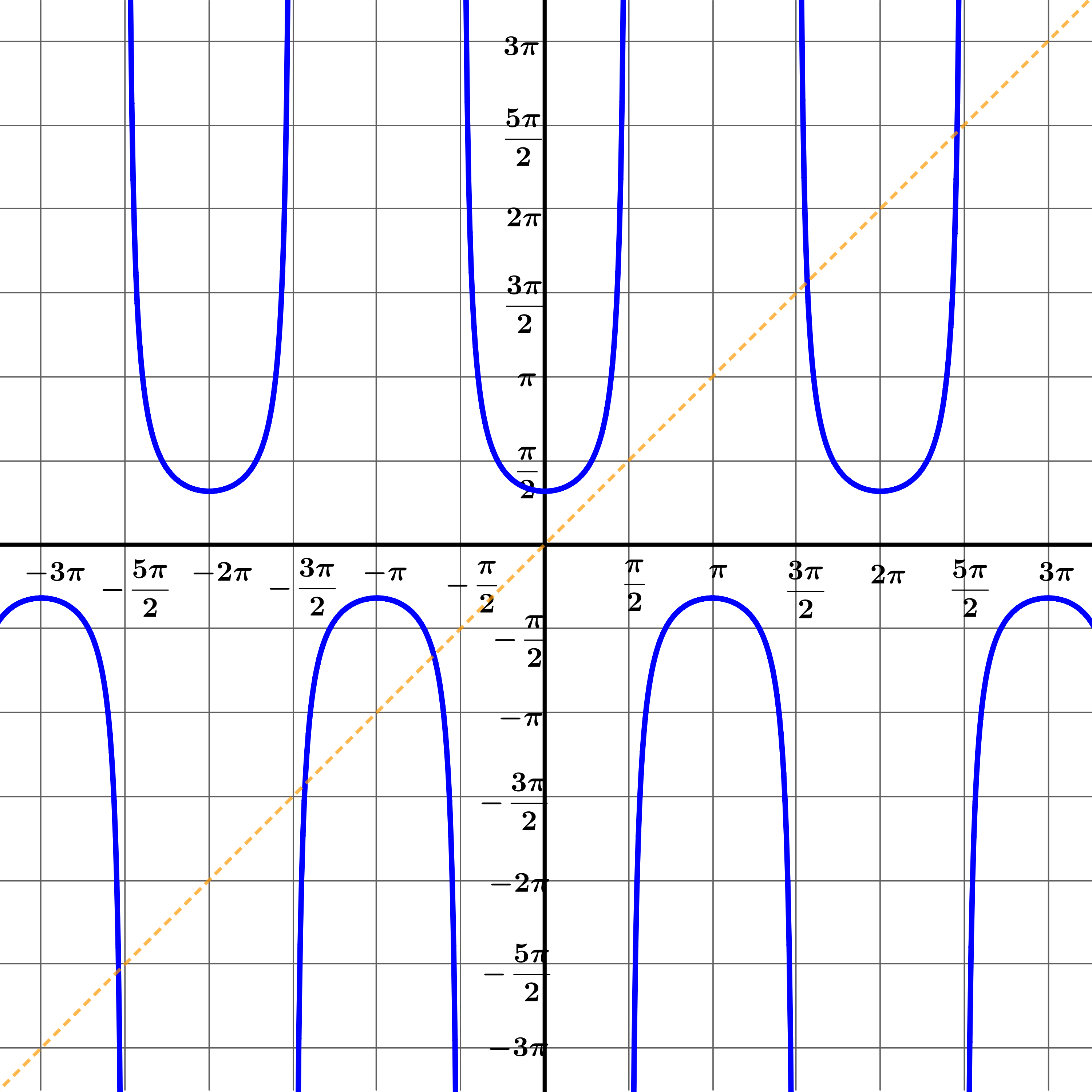
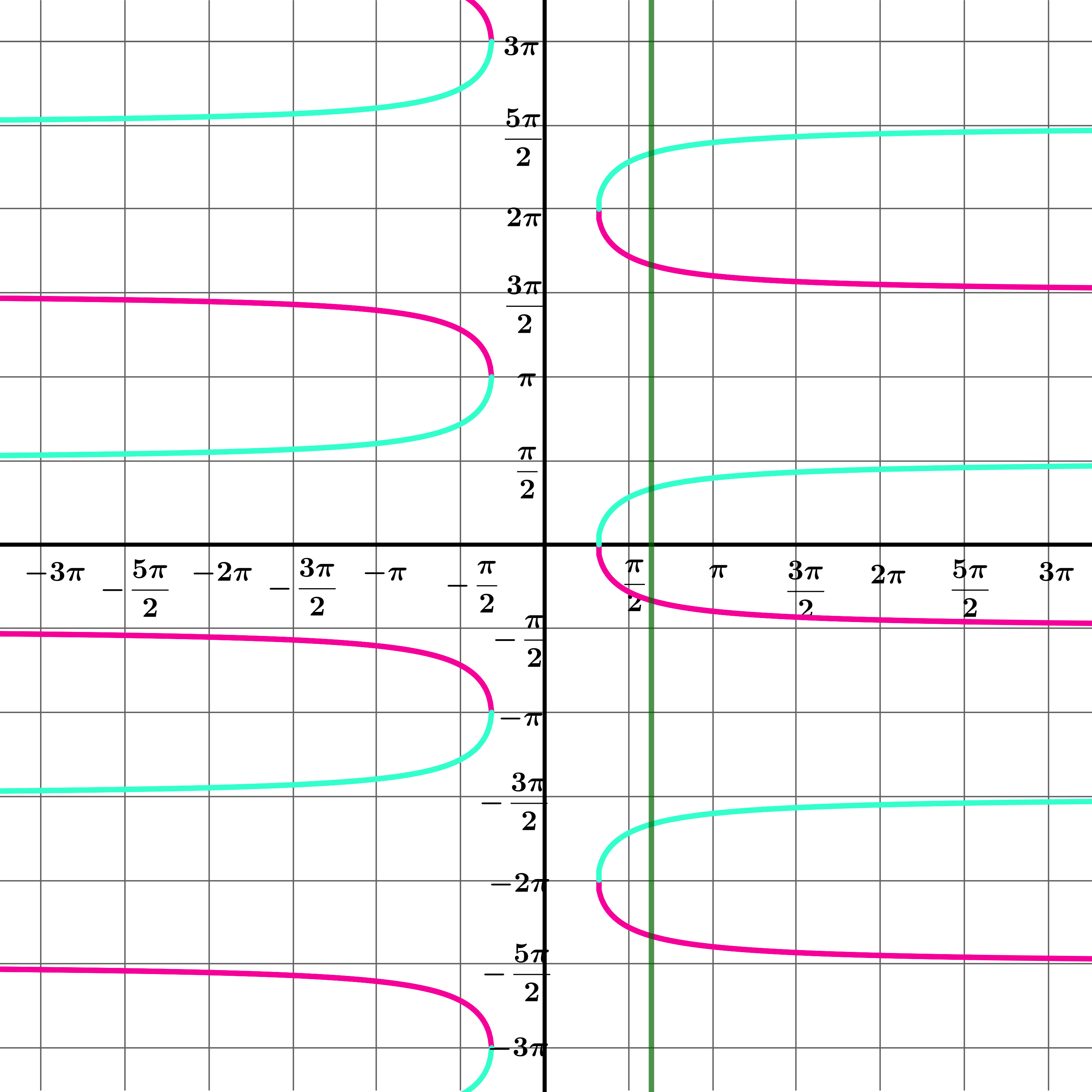
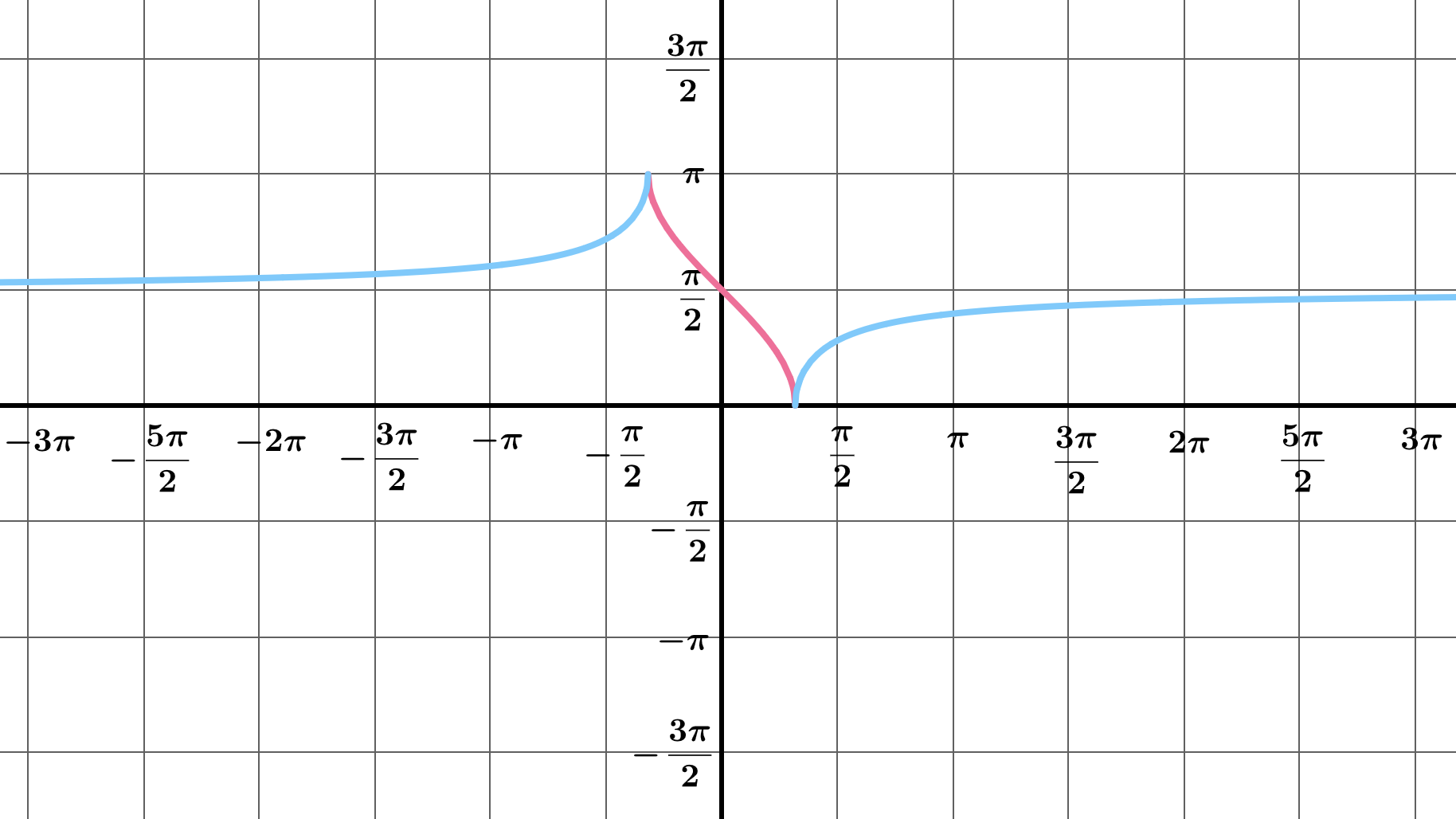
Here is the graph \(y=\sec x\). Draw this graph, and, on the same set of axes, draw the graph \(x=\sec y\).
Why is the graph \(x=\sec y\) not the same as the graph \(y=\mathrm{arcsec} \,x\)?
For the graph to represent a function, the vertical line must only ever intersect the graph at a single point.
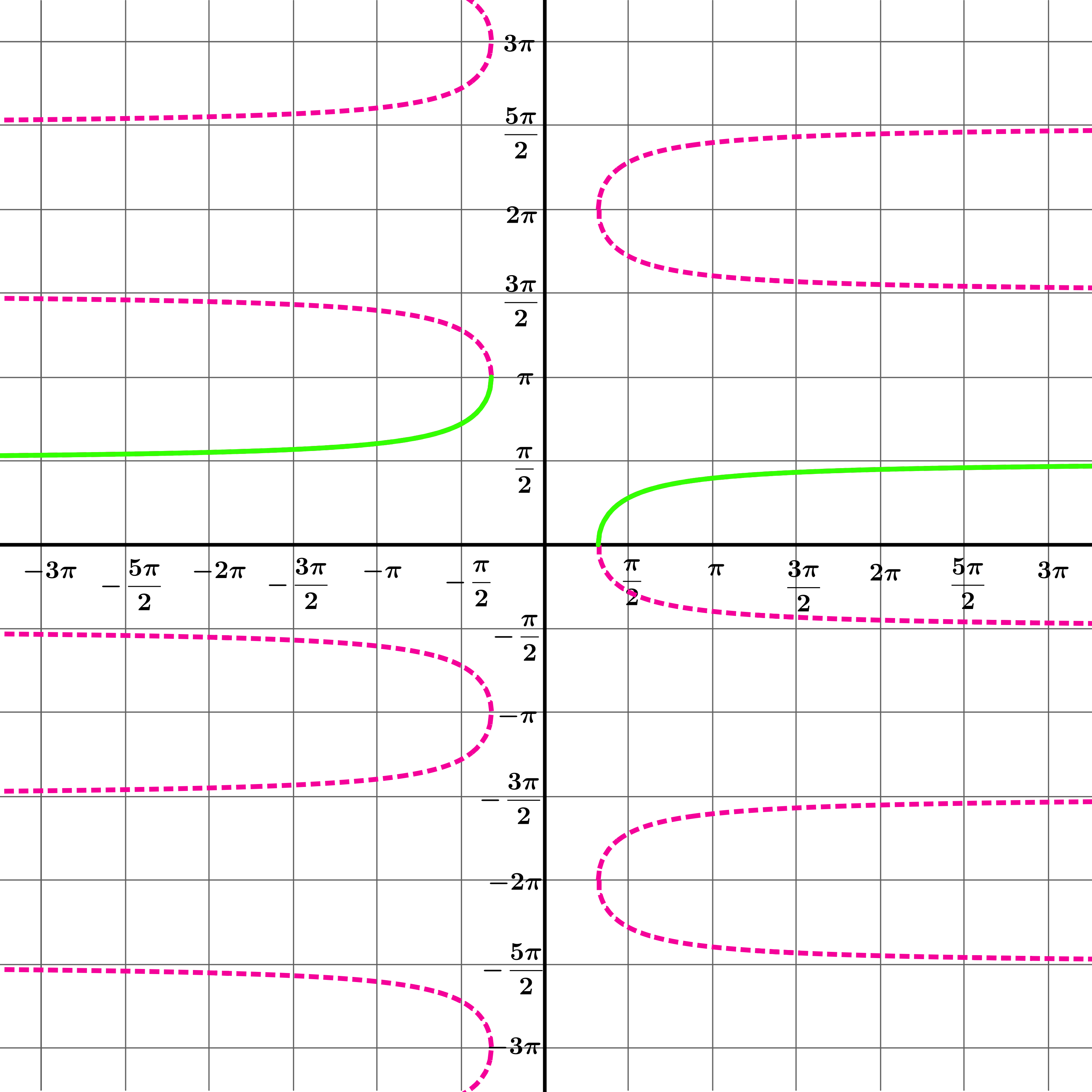
How can we choose part of the graph \(x=\sec y\) to create a sensible graph of the function
\(y=\operatorname{arcsec}x\)?
If this is the graph \(y=\mathrm{arcsec}\,x\), what are the domain and the range of the function arcsec?
\[\begin{aligned}
&\text{Domain: } (-\infty,-1]\cup[1,\infty)\\[6pt]
&\text{Range: } \left[0,\, \pi\right]\setminus\left\{\frac{\pi}{2}\right\}
\end{aligned}\]
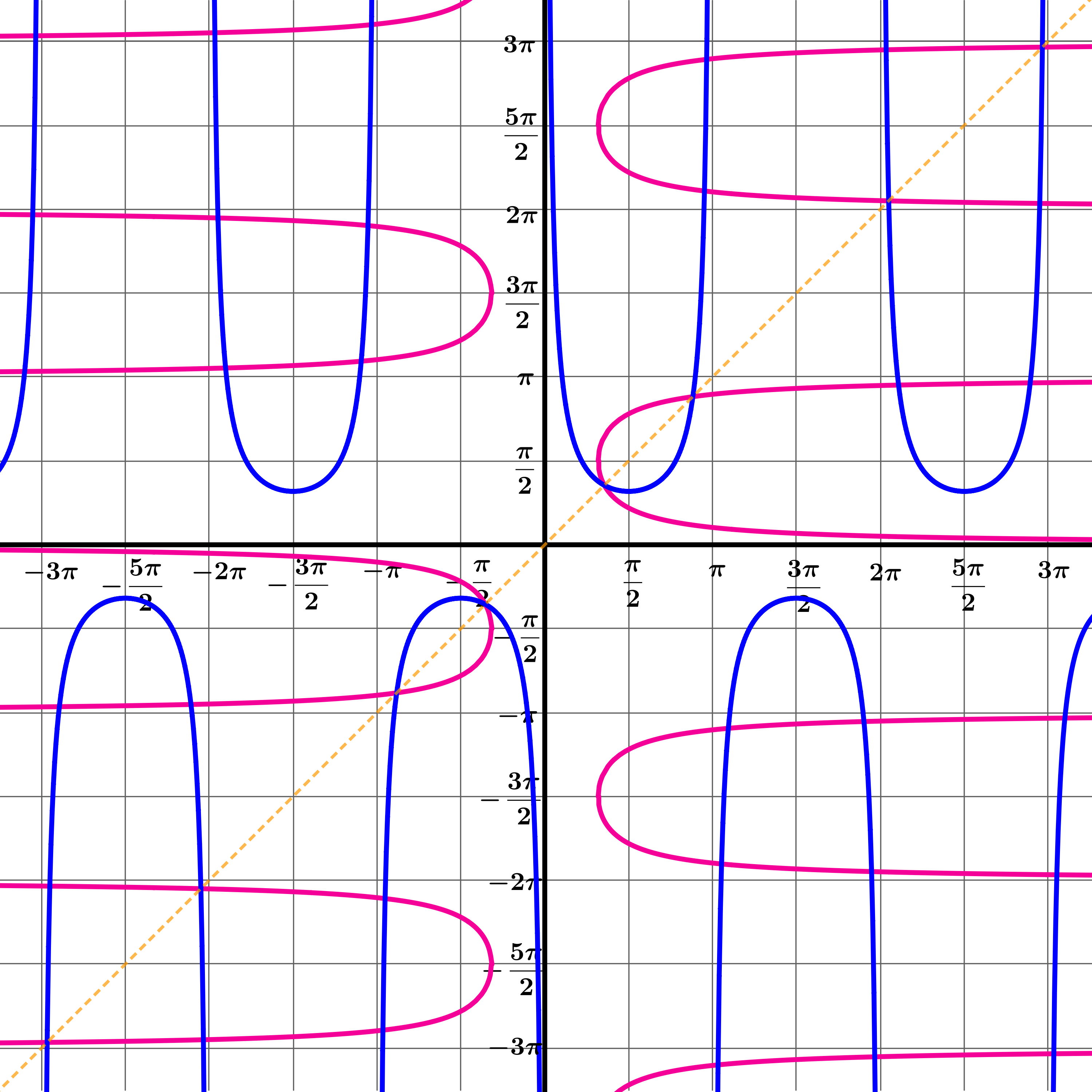
Draw the graphs \(y=\mathrm{cosec}\,x\) and \(x=\mathrm{cosec}\,y\) on the same set of axes.
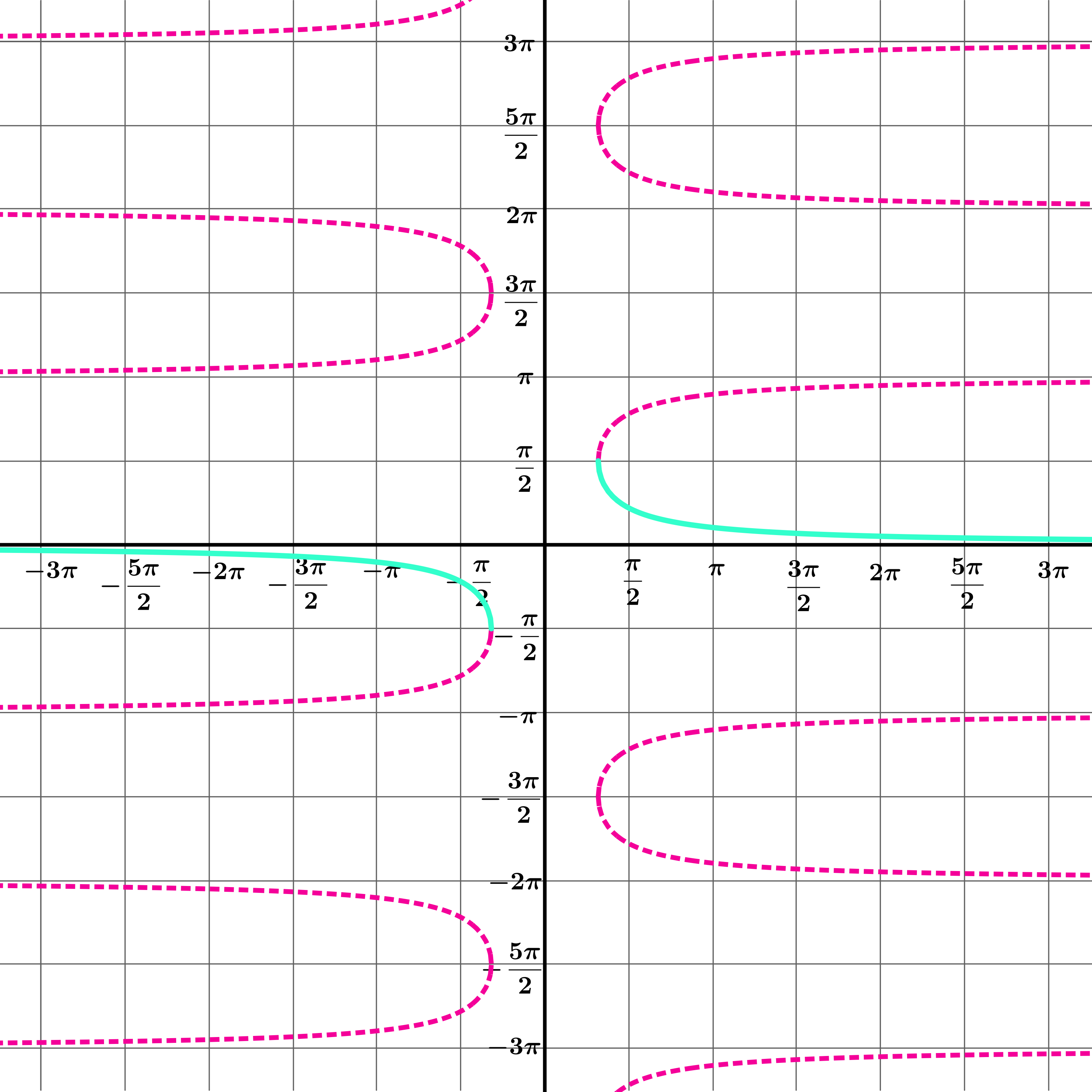
How can we choose part of the graph \(x=\mathrm{cosec}\, y\) to create a sensible graph of the function \(y=\mathrm{arccosec}\,x\)?
What are the domain and range of the function arccosec?
\[\begin{aligned}
&\text{Domain: } (-\infty,-1]\cup[1,\infty)\\[6pt]
&\text{Range: } \left[-\tfrac{\pi}{2},\, \tfrac{\pi}{2}\right]\setminus\{0\}
\end{aligned}\]
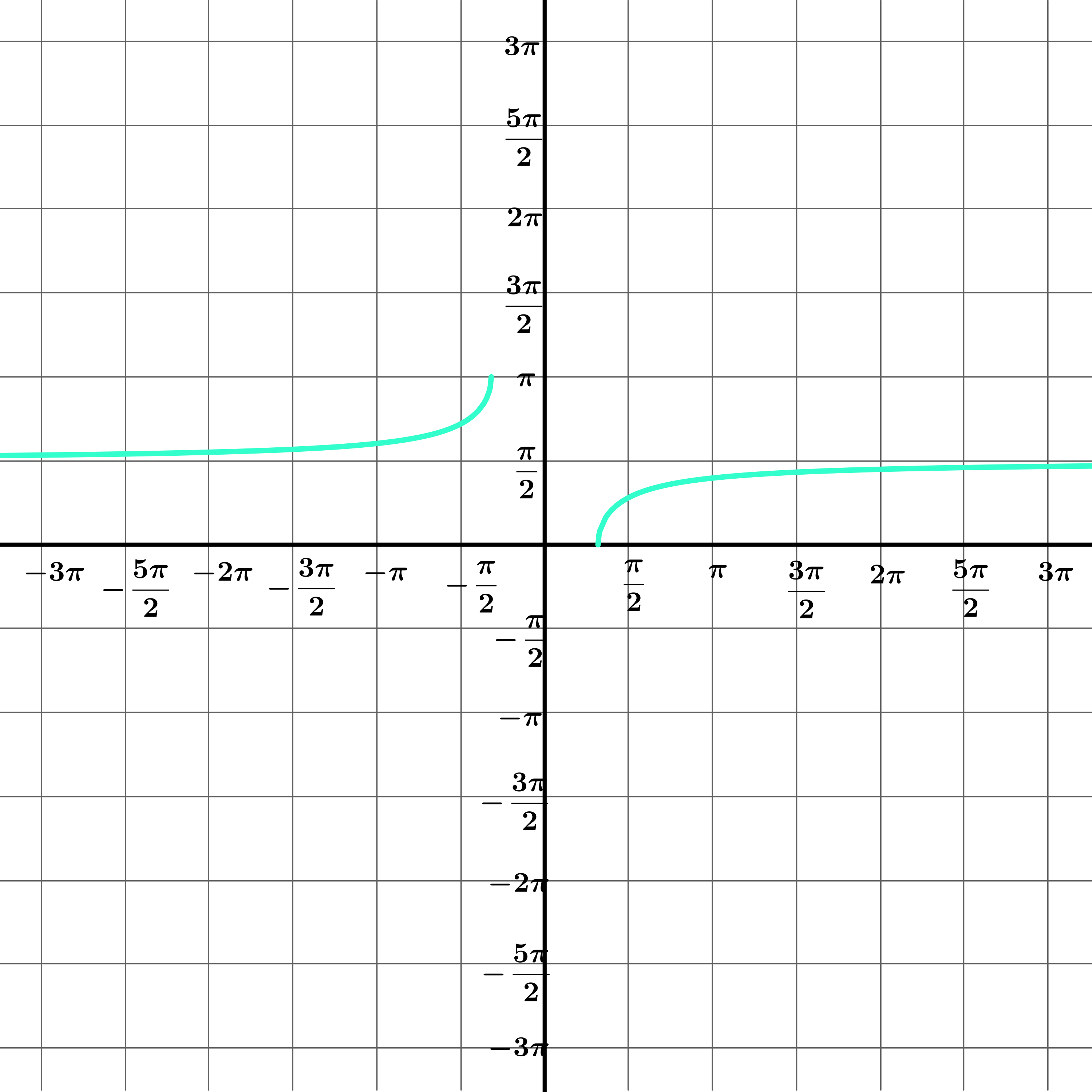
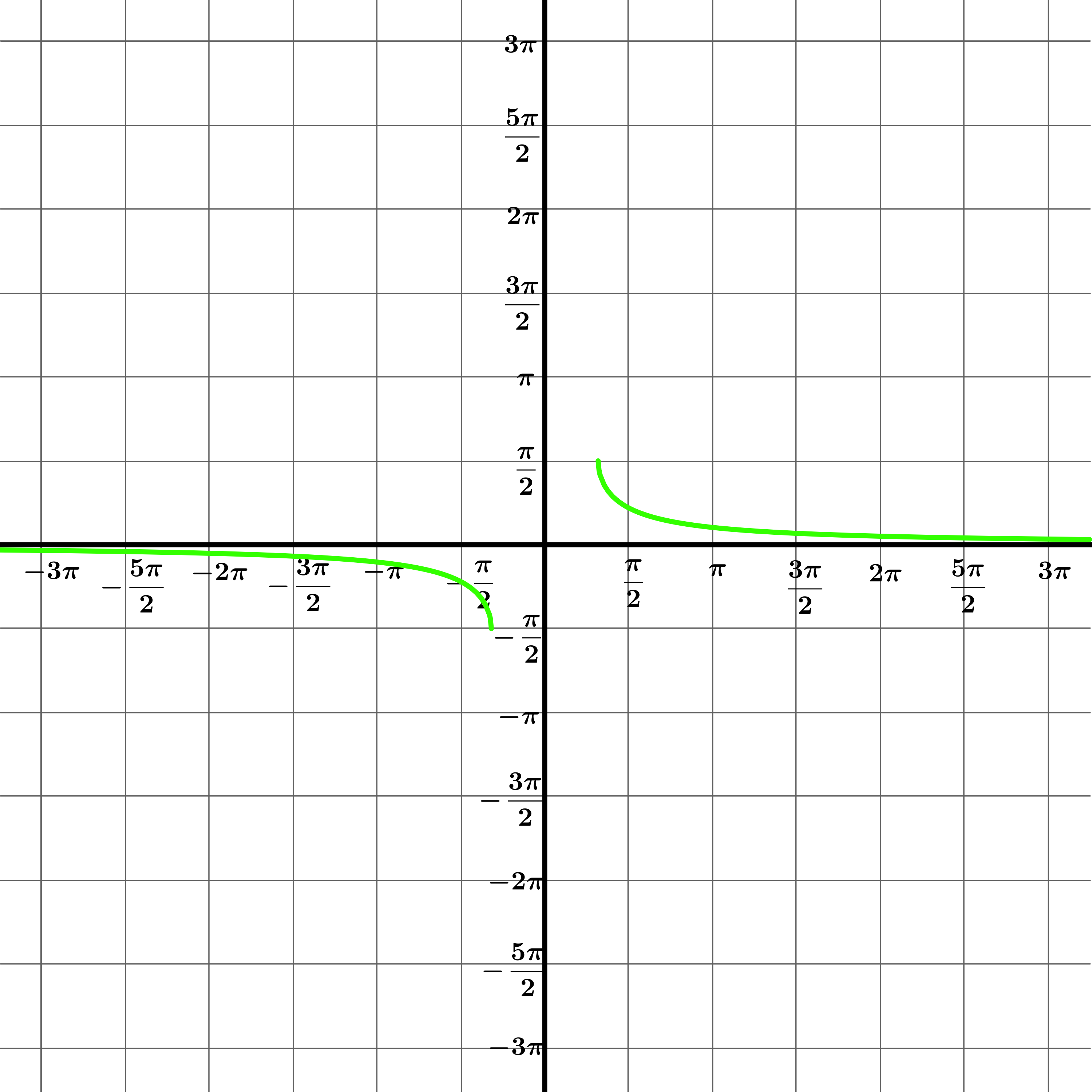
Draw the graphs \(y=\cot x\) and \(x=\cot y\).
Use this to draw the graph \(y=\mathrm{arccot}\,x\)
\[\begin{aligned}
&\text{Domain: } \mathbb{R}\\[6pt]
&\text{Range: } (0,\,\pi)
\end{aligned}\]
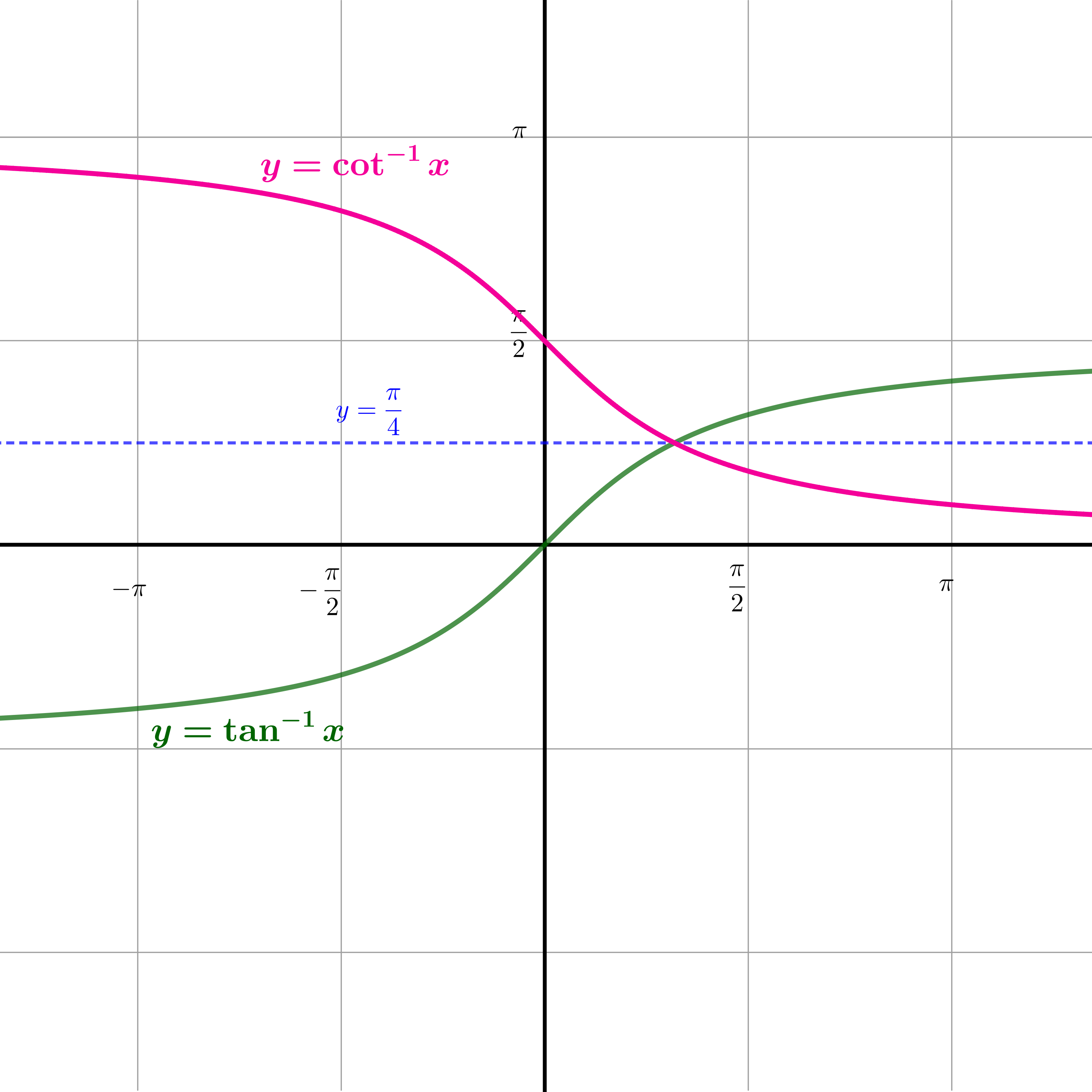
The graphs of \(y = \operatorname{arccot} x\) and \(y = \arctan x\) are shown together below.
What symmetry do you observe? Use it to state the value of \(\operatorname{arccot} x + \arctan x\).
The average of \(\operatorname{arccot} x\) and \(\arctan x\) is\(\displaystyle{\frac{\pi}{4}}\). So
\[\operatorname{arccot} x + \arctan x=\frac{\pi}{2}
\]
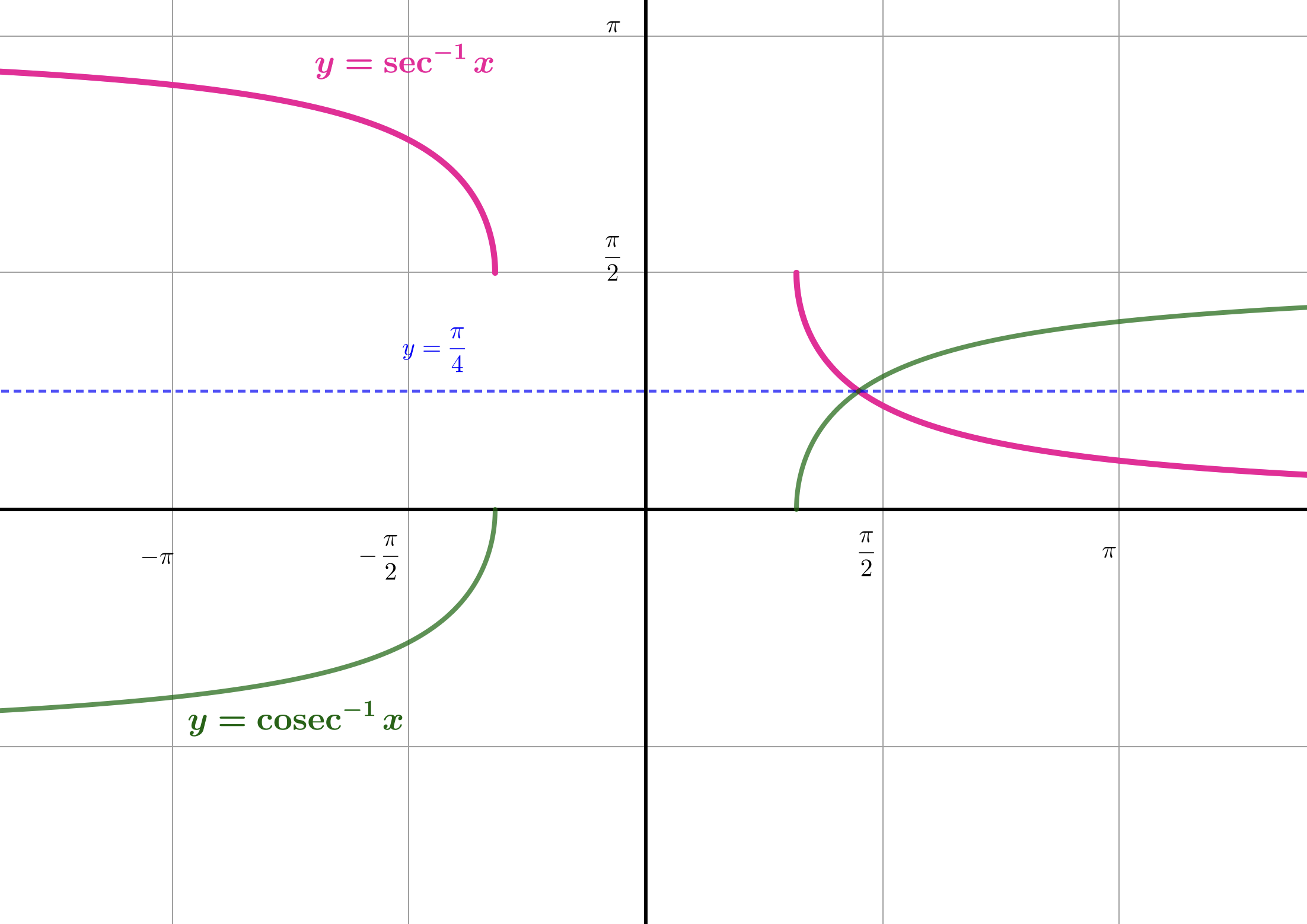
The graphs of \(y = \operatorname{arcsec} x\) and \(y = \operatorname{arccosec} x\) are shown together below.
What symmetry do you observe? Use it to state the value of \(\operatorname{arcsec} x + \operatorname{arccosec} x\).
The average of \(\operatorname{arcsec} x\) and \(\operatorname{arccosec} x\) is \(\displaystyle{\frac{\pi}{4}}\) So
\[\operatorname{arcsec} x + \operatorname{arccosec} x=
\frac{\pi}{2}
\]
Find the differential of \(\operatorname{arcsec} x\).
\(y = \operatorname{arcsec}x \Rightarrow x\)
\(=\)
\(\sec y\)
\(\Rightarrow\dfrac{\mathrm{d}x}{\mathrm{d}y}\)
\(=\)
\(\sec y\tan y\)
\(\Rightarrow\dfrac{\mathrm{d}y}{\mathrm{d}x}\)
\(=\)
\(\pm\dfrac{1}{x\sqrt{1-x^2}}\)
but gradient is always positive
\(\Rightarrow\dfrac{\mathrm{d}y}{\mathrm{d}x}\)
\(=\)
\(\dfrac{1}{|x|\sqrt{1-x^2}}=\dfrac{1}{\sqrt{x^2(1-x^2)}}\)
Find the differential of \(\operatorname{arccsc} x\).
\(y = \operatorname{arccosec}x \Rightarrow x\)
\(=\)
\(\operatorname{cosec} y\)
\(\Rightarrow\dfrac{\mathrm{d}x}{\mathrm{d}y}\)
\(=\)
\(-\operatorname{cosec} y\cot y\)
\(\Rightarrow\dfrac{\mathrm{d}y}{\mathrm{d}x}\)
\(=\)
\(\pm\dfrac{1}{x\sqrt{1-x^2}}\)
but gradient is always negative
\(\Rightarrow\dfrac{\mathrm{d}y}{\mathrm{d}x}\)
\(=\)
\(-\dfrac{1}{|x|\sqrt{1-x^2}}=-\dfrac{1}{\sqrt{x^2(1-x^2)}}\)
Find the differential of \(\operatorname{arccot} x\).
\(y = \operatorname{arccot}x \Rightarrow x\)
\(=\)
\(\cot y\)
\(\Rightarrow\dfrac{\mathrm{d}x}{\mathrm{d}y}\)
\(=\)
\(-\operatorname{cosec}^2 y\)
\(\Rightarrow\dfrac{\mathrm{d}y}{\mathrm{d}x}\)
\(=\)
\(-\dfrac{1}{\operatorname{cosec}^2 y}=-\dfrac{1}{1+x^2}\)
Find (using integration by parts) \[\int_1^2 \operatorname{arcsec}x\,\mathrm{d}x\]
\(u=\operatorname{arcsec}x\qquad \dfrac{\mathrm{d}v}{\mathrm{d}x}=1\)
\(\dfrac{\mathrm{d}u}{\mathrm{d}x}=\dfrac{1}{x\sqrt{x^2-1}}\qquad v=x\)
\(\displaystyle\int_1^2 \operatorname{arcsec}x\,\mathrm{d}x\)
\(=\)
\(uv-\displaystyle\int v \,\mathrm{d}u\)
\(=\)
\(\Big[x\operatorname{arcsec}x\Big]_1^2-\displaystyle\int_1^2 \frac{1}{\sqrt{x^2-1}}\,\mathrm{d}x\)
Use the substitution \(x=\sec u\) to find \[\int_1^2 \frac{1}{\sqrt{x^2-1}}\,\mathrm{d}x\]
\(\displaystyle\int_1^2 \frac{1}{\sqrt{x^2-1}}\,\mathrm{d}x\)
\(x=\sec u\qquad \dfrac{\mathrm{d}x}{\mathrm{d}u}=\sec u\tan u\)
\(\displaystyle\int_1^2 \frac{1}{\sqrt{x^2-1}}\,\mathrm{d}x\)
\(=\)
\(\displaystyle\int_0^\frac{\pi}{3} \frac{1}{\sqrt{x^2-1}}\frac{\mathrm{d}x}{\mathrm{d}u}\,\mathrm{d}u\)
\(=\)
\(\displaystyle\int_0^\frac{\pi}{3} \frac{1}{\sqrt{x^2-1}}\sec u\tan u\,\mathrm{d}u\)
\(=\)
\(\displaystyle\int_0^\frac{\pi}{3} \frac{1}{\tan u}\sec u\tan u\,\mathrm{d}u\qquad\) as \(\tan u
\geqslant 0\) in this range
\(=\)
\(\displaystyle\int_0^\frac{\pi}{3} \sec u\,\mathrm{d}u\)
\(=\)
\(\Big[\ln|\sec u+\tan u|\Big]_0^\frac{\pi}{3}=\ln\left(2+\sqrt{3}\right)\)
\(=\)
\(\Bigg[\ln\left|x+\sqrt{x^2-1}\right|\Bigg]_1^2=\ln\left(2+\sqrt{3}\right)\)
Use this result to find\[\int_1^2 \operatorname{arcsec}x\,\mathrm{d}x\]
\(\displaystyle\int_1^2 \operatorname{arcsec}x\,\mathrm{d}x\)
\(=\)
\(\Big[x\operatorname{arcsec}x\Big]_1^2-\displaystyle\int_1^2 \frac{1}{\sqrt{x^2-1}}\,\mathrm{d}x\)
\(=\)
\(\displaystyle\frac{2\pi}{3}-\ln\left(2+\sqrt 3\right)\)
Find (using integration by parts) \[\int_{-2}^{-1} \operatorname{arcsec}x\,\mathrm{d}x\]
\(u=\operatorname{arcsec}x\qquad \dfrac{\mathrm{d}v}{\mathrm{d}x}=1\)
\(\dfrac{\mathrm{d}u}{\mathrm{d}x}=\dfrac{1}{x\sqrt{x^2-1}}\qquad v=x\)
\(\displaystyle\int_{-2}^{-1} \operatorname{arcsec}x\,\mathrm{d}x\)
\(=\)
\(uv-\displaystyle\int v \,\mathrm{d}u\)
\(=\)
\(\Big[x\operatorname{arcsec}x\Big]_{-2}^{-1}-\displaystyle\int_{-2}^{-1} \frac{1}{\sqrt{x^2-1}}\,\mathrm{d}x\)
Use the substitution \(x=\sec u\) to find \[\int_{-2}^{-1} \frac{1}{\sqrt{x^2-1}}\,\mathrm{d}x\]
\(\displaystyle\int_{-2}^{-1} \frac{1}{\sqrt{x^2-1}}\,\mathrm{d}x\)
\(x=\sec u\qquad \dfrac{\mathrm{d}x}{\mathrm{d}u}=\sec u\tan u\)
\(\displaystyle\int_{-2}^{-1} \frac{1}{\sqrt{x^2-1}}\,\mathrm{d}x\)
\(=\)
\(\displaystyle\int_\frac{2\pi}{3}^\pi \frac{1}{\sqrt{x^2-1}}\frac{\mathrm{d}x}{\mathrm{d}u}\,\mathrm{d}u\)
\(=\)
\(\displaystyle\int_\frac{2\pi}{3}^\pi \frac{1}{\sqrt{x^2-1}}\sec u\tan u\,\mathrm{d}u\)
\(=\)
\(-\displaystyle\int_\frac{2\pi}{3}^\pi \frac{1}{\tan u}\sec u\tan u\,\mathrm{d}u\qquad\) as \(\tan u
\leqslant 0\) in this range
\(=\)
\(-\displaystyle\int_\frac{2\pi}{3}^\pi \sec u\,\mathrm{d}u\)
\(=\)
\(-\Big[\ln|\sec u+\tan u|\Big]_\frac{2\pi}{3}^\pi=\ln\left(2+\sqrt{3}\right)\)
\(=\)
\(-\Bigg[\ln\left|x-\sqrt{x^2-1}\right|\Bigg]_{-2}^{-1}=\ln\left(2+\sqrt{3}\right)\)
Use this result to find\[\int_{-2}^{-1} \operatorname{arcsec}x\,\mathrm{d}x\]
\(\displaystyle\int_{-2}^{-1} \operatorname{arcsec}x\,\mathrm{d}x\)
\(=\)
\(\Big[x\operatorname{arcsec}x\Big]_{-2}^{-1}-\displaystyle\int_{-2}^{-1} \frac{1}{\sqrt{x^2-1}}\,\mathrm{d}x\)
\(=\)
\(\displaystyle\frac{4\pi}{3}-\ln\left(2+\sqrt 3\right)\)
Find (using integration by parts) \[\int_1^2 \operatorname{arccosec}x\,\mathrm{d}x\]
\(u=\operatorname{arccosec}x\qquad \dfrac{\mathrm{d}v}{\mathrm{d}x}=1\)
\(\dfrac{\mathrm{d}u}{\mathrm{d}x}=-\dfrac{1}{x\sqrt{x^2-1}}\qquad v=x\)
\(\displaystyle\int_1^2 \operatorname{arccosec}x\,\mathrm{d}x\)
\(=\)
\(uv-\displaystyle\int v \,\mathrm{d}u\)
\(=\)
\(\Big[x\operatorname{arccosec}x\Big]_1^2+\displaystyle\int_1^2 \frac{1}{\sqrt{x^2-1}}\,\mathrm{d}x\)
Using the result \[\int_1^2 \frac{1}{\sqrt{x^2-1}}\,\mathrm{d}x=\ln\left(2+\sqrt{3}\right)\] (found earlier by the substitution \(x=\sec u\)), find \[\int_1^2 \operatorname{arccosec}x\,\mathrm{d}x\]
\(\displaystyle\int_1^2 \operatorname{arccosec}x\,\mathrm{d}x\)
\(=\)
\(\Big[x\operatorname{arccosec}x\Big]_1^2+\displaystyle\int_1^2 \frac{1}{\sqrt{x^2-1}}\,\mathrm{d}x\)
\(=\)
\(\ln\left(2+\sqrt 3\right)-\displaystyle\frac{\pi}{6}\)
Find (using integration by parts) \[\int_{-2}^{-1} \operatorname{arccosec}x\,\mathrm{d}x\]
\(u=\operatorname{arccosec}x\qquad \dfrac{\mathrm{d}v}{\mathrm{d}x}=1\)
\(\dfrac{\mathrm{d}u}{\mathrm{d}x}=-\dfrac{1}{x\sqrt{x^2-1}}\qquad v=x\)
\(\displaystyle\int_{-2}^{-1} \operatorname{arccosec}x\,\mathrm{d}x\)
\(=\)
\(uv-\displaystyle\int v \,\mathrm{d}u\)
\(=\)
\(\Big[x\operatorname{arccosec}x\Big]_{-2}^{-1}+\displaystyle\int_{-2}^{-1} \frac{1}{\sqrt{x^2-1}}\,\mathrm{d}x\)
Using the result \[\int_{-2}^{-1} \frac{1}{\sqrt{x^2-1}}\,\mathrm{d}x=\ln\left(2+\sqrt{3}\right)\] (found earlier by the substitution \(x=\sec u\)), find \[\int_{-2}^{-1} \operatorname{arccosec}x\,\mathrm{d}x\]
\(\displaystyle\int_{-2}^{-1} \operatorname{arccosec}x\,\mathrm{d}x\)
\(=\)
\(\Big[x\operatorname{arccosec}x\Big]_{-2}^{-1}+\displaystyle\int_{-2}^{-1} \frac{1}{\sqrt{x^2-1}}\,\mathrm{d}x\)
\(=\)
\(\ln\left(2+\sqrt 3\right)+\displaystyle\frac{\pi}{6}\)
Find (using integration by parts) \[\int \operatorname{arccot}x\,\mathrm{d}x\]
\(u=\operatorname{arccot}x\qquad \dfrac{\mathrm{d}v}{\mathrm{d}x}=1\)
\(\dfrac{\mathrm{d}u}{\mathrm{d}x}=-\dfrac{1}{1+x^2}\qquad v=x\)
\(\displaystyle\int \operatorname{arccot}x\,\mathrm{d}x\)
\(=\)
\(uv-\displaystyle\int v \,\mathrm{d}u\)
\(=\)
\(x\operatorname{arccot}x+\displaystyle\int x\frac{1}{1+x^2}\,\mathrm{d}x\)
\(=\)
\(x\operatorname{arccot}x+\frac{1}{2}\ln\left(1+x^2\right)+c\)
 Dr Brian Brooks