Welcome to Inverse Circular Functions: Part 1

This stage introduces the inverse circular functions — arcsin, arccos, and arctan. You'll discover how to define these functions carefully using graphs, and understand their domains and ranges.

Think carefully about domains and ranges — they are essential for defining inverse functions!
Dr Brian Brooks
Mathematics InSight

We are very used to the idea of inverse functions as somehow "undoing" a function. For example, the inverse of the function \(f(x)=e^x\) is \(f^{-1}x=\ln x\). Or for a more basic example, the inverse of the function \(g(x)=2x-3\) is the function \(g^{-1}(x)=\frac{x+3}{2}\).

Hopefully, we are also familiar with the idea that the graphs of a pair of inverse functions are reflections of eachother in the line \(y=x\). If this idea is unfamiliar to you, it would be worth spending a bit of research time figuring out why this should be before tackling the inverse circular functions.

A trickier example is the function \(f(x)=x^2\). If \(f^{-1}\) is its inverse, what is \(f^{-1}(4)\)?

If \(f^{-1}(4)=2\), what are \(f\circ f^{-1}(4)\) and \(f^{-1}\circ f(2)\)?

If \(f^{-1}(4)=2\), then \(f\circ f^{-1}(4)=f(2)=4\) and \(f^{-1}\circ f(2)=f^{-1}(4)=2\).

If \(f^{-1}(4)=-2\), what are \(f\circ f^{-1}(4)\) and \(f^{-1}\circ f(2)\)?

If \(f^{-1}(4)=2\), then \(f\circ f^{-1}(4)=f(-2)=4\) and \(f^{-1}\circ f(-2)=f^{-1}(4)=-2\).

In either case, \(f\) and \(f^{-1}\) seem to undo each other, so that either value for \(f^{-1}(4)\) is perfectly reasonable.

But we need to know what \(f^{-1}(4)\) actually is; in fact, we need to know what \(f^{-1}(x)\) actually is for any \(x\geqslant 0\).

Let's take a look at this from a graphical point of view.

Draw the graph \(y=x^2\) and the line \(y=x\), and then reflect the curve in the line.

What is the equation of the reflected curve?

The equation of the reflected curve is \(x=y^2\).

On the same set of axes, draw the graph \(y=\sqrt x\) and reflect it in the line \(y=x\).

What is the equation of the reflected curve?

The equation of the reflected curve is \(y=x^2\) but only defined when \(x\geqslant 0\).

In terms of functions, we could say that it's the graph of the function \(f(x)=x^2\) where the domain of the function is \(\{x\in \mathbb{R}|x\geqslant 0\}\).

On the same set of axes, draw the graph \(y=-\sqrt x\) and reflect it in the line \(y=x\).

What is the equation of the reflected curve?

The equation of the reflected curve is \(y=x^2\) but only defined when \(x\leqslant 0\).

In terms of functions, we could say that it's the graph of the function \(f(x)=x^2\) where the domain of the function is \(\{x\in \mathbb{R}|x\leqslant 0\}\).

The inverse of the function

\[f(x)=x^2\text{ with domain }\{x\in \mathbb{R}|x\geqslant 0\}\text{ is}\] \[f^{-1}(x)=\sqrt x\]

and the inverse of the function

\[f(x)=x^2\text{ with domain }\{x\in \mathbb{R}|x\leqslant 0\}\text{ is}\] \[f^{-1}(x)=-\sqrt x\]

When it comes to finding the inverses of the circular functions, we face a similar difficulty with a similar solution — only it's all a bit more complicated.

If we are only thinking about right-angled triangles, there is no problem at all. For example,

\[\sin\frac{\pi}{6}=\frac{1}{2} \text{ and } \sin^{-1}\frac{1}{2}=\frac{\pi}{6}\]

This is something you are already very used to. We could also write \(\arcsin\) instead of \(\sin^{-1}\). They mean the same thing, but you should get used to both notations.

When we move to general circular functions, we need to take rather more care!
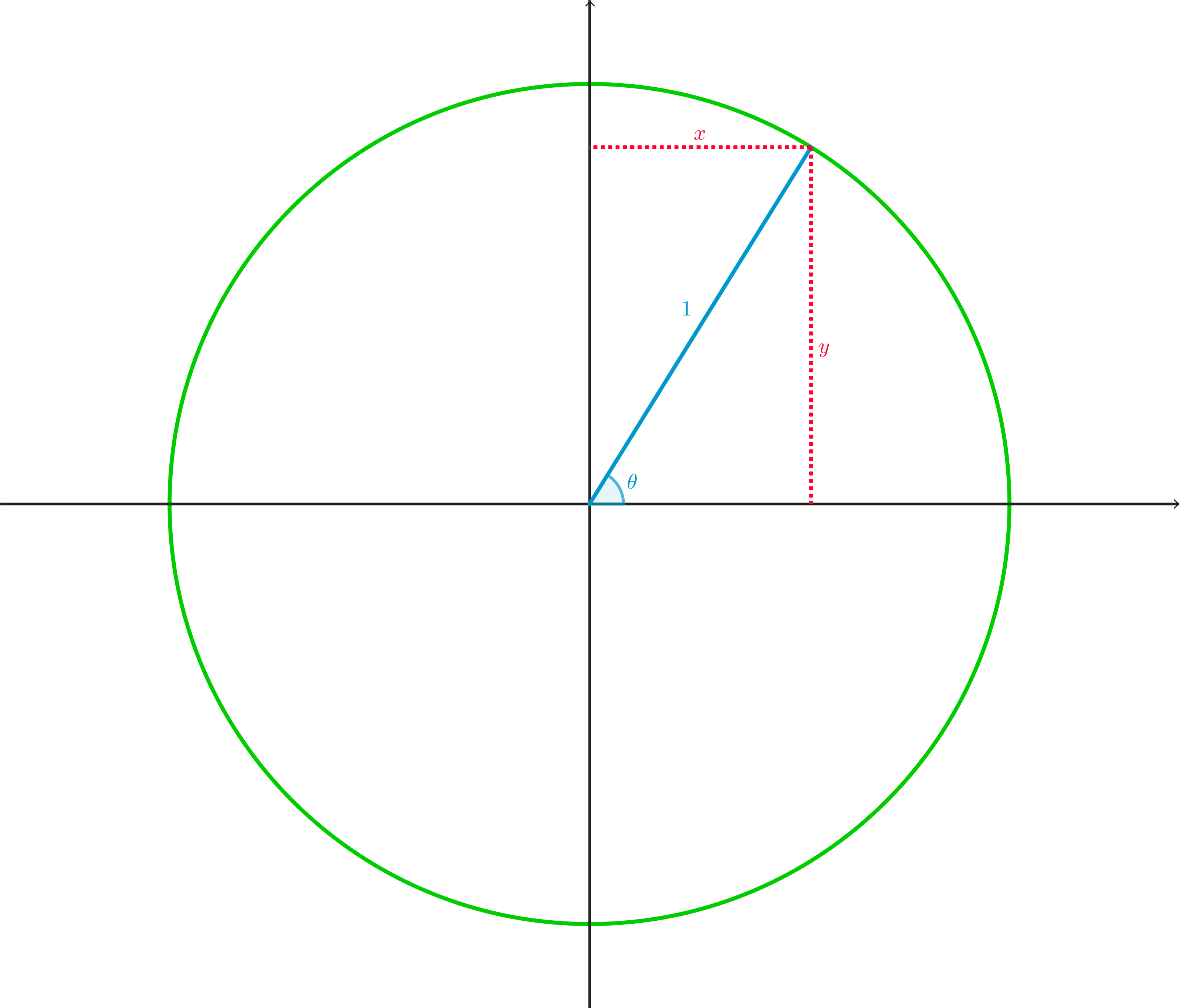
When \(0 \leq \theta \leq \displaystyle\frac{\pi}{2}\):

Unit circle diagram

What is \(x\) in terms of \(\theta\)?

\(x=\cos\theta\)

What is \(\theta\) in terms of \(x\)?

\(\theta=\cos^{-1}x=\arccos x\)

What is \(y\) in terms of \(\theta\)?

What is \(\theta\) in terms of \(y\)?

What is \(\displaystyle{\frac{y}{x}}\) in terms of \(\theta\)?

What is \(\theta\) in terms of \(\displaystyle{\frac{y}{x}}\) ?

\[\begin{aligned} & \cos\theta = x\qquad\sin\theta = y\qquad\tan\theta = \frac{y}{x} \\ \phantom{-} & \\ & \Rightarrow \theta = \arccos x = \arcsin y = \arctan\frac{y}{x} \end{aligned}\]

So long as \(0 \leq \theta \leq \displaystyle\frac{\pi}{2}\), there is only one value of \(\theta\) that makes \(x = \cos\theta\), \(\;y = \sin\theta\), and \(\;\displaystyle\frac{y}{x} = \tan\theta\). So we know exactly what angle we mean by \(\arccos x\), \(\arcsin y\), or \(\arctan\displaystyle\frac{y}{x}\).

Solve the equation \(\sin\theta=\frac{\sqrt 3}{2}\).

\[\begin{align*} \theta=&\frac{\pi}{3},\;\frac{2\pi}{3},\;\frac{7\pi}{3},\;\frac{8\pi}{3}\dots\\ &-\frac{4\pi}{3},\;-\frac{5\pi}{3},\;-\frac{10\pi}{3},\;-\frac{11\pi}{3} \end{align*}\]
\[\begin{align*} \sin\frac{\pi}{3}&=\sin\frac{2\pi}{3}=\sin\frac{7\pi}{3}=\sin\frac{8\pi}{3}\dots\\ &=\sin\left(-\frac{4\pi}{3}\right)=\sin\left(-\frac{5\pi}{3}\right)=\sin\left(-\frac{10\pi}{3}\right)=\sin\left(-\frac{11\pi}{3}\right)\\ &=\frac{\sqrt 3}{2} \end{align*}\]
What is \(\displaystyle{\arcsin\frac{\sqrt 3}{2}}\) ?
\(\arcsin\frac{\sqrt 3}{2}=\frac{\pi}{3}\)
Figure these out without a calculator: \[\begin{array}{ll} \arcsin \left(\sin\dfrac{\pi}{3}\right) &\qquad \arcsin \left(\sin\dfrac{2\pi}{3}\right)\\[16pt] \arcsin \left(\sin\dfrac{7\pi}{3}\right) &\qquad \arcsin \left(\sin\dfrac{8\pi}{3}\right)\\[16pt] \arcsin \left(\sin\left(-\dfrac{4\pi}{3}\right)\right) &\qquad \arcsin \left(\sin\left(-\dfrac{5\pi}{3}\right)\right)\\[16pt] \arcsin \left(\sin\left(-\dfrac{10\pi}{3}\right)\right) &\qquad \arcsin \left(\sin\left(-\dfrac{11\pi}{3}\right)\right) \end{array}\]
\[\begin{align*} \arcsin \left(\sin\frac{\pi}{3}\right)&=\arcsin\frac{\sqrt 3}{2}=\frac{\pi}{3}\\[12pt] \arcsin \left(\sin\frac{2\pi}{3}\right)&=\arcsin \left(\sin\frac{7\pi}{3}\right)=\arcsin \left(\sin\frac{8\pi}{3}\right)\\[12pt] &=\arcsin \left(\sin\left(-\frac{4\pi}{3}\right)\right)=\arcsin \left(\sin\left(-\frac{5\pi}{3}\right)\right)\\[12pt] &=\arcsin \left(\sin\left(-\frac{10\pi}{3}\right)\right)= \arcsin \left(\sin\left(-\frac{11\pi}{3}\right)\right)\\[12pt] &=\arcsin\frac{\sqrt 3}{2}\\[6pt] &=\frac{\pi}{3}\\[12pt] \end{align*}\]
If \(\theta\) is between \(-\frac{\pi}{2}\) and \(0\), then \(\sin\theta< 0\). For example, \[\begin{align*} \sin\left(-\frac{\pi}{3}\right)=-\frac{\sqrt 3}{2}\text{ and}\\[6pt] \arcsin\left(-\frac{\sqrt 3}{2}\right)=-\frac{\pi}{3} \end{align*}\]
Figure these out without a calculator: \[\begin{array}{ll} \arcsin \left(\sin\left(-\dfrac{\pi}{3}\right)\right) &\qquad \arcsin \left(\sin\left(-\dfrac{2\pi}{3}\right)\right)\\[16pt] \arcsin \left(\sin\left(-\dfrac{7\pi}{3}\right)\right) &\qquad \arcsin \left(\sin\left(-\dfrac{8\pi}{3}\right)\right)\\[16pt] \arcsin \left(\sin\dfrac{4\pi}{3}\right) &\qquad \arcsin \left(\sin\dfrac{5\pi}{3}\right)\\[16pt] \arcsin \left(\sin\dfrac{10\pi}{3}\right) &\qquad \arcsin \left(\sin\dfrac{11\pi}{3}\right) \end{array}\]
\[\begin{align*} \arcsin \left(\sin\left(-\frac{\pi}{3}\right)\right)&= \arcsin \left(\sin\left(-\frac{2\pi}{3}\right)\right)= \arcsin \left(\sin\left(-\frac{7\pi}{3}\right)\right)\\[12pt] &=\arcsin \left(\sin\left(-\frac{8\pi}{3}\right)\right)= \arcsin \left(\sin\frac{4\pi}{3}\right) =\arcsin \left(\sin\frac{5\pi}{3}\right)\\[12pt] &=\arcsin \left(\sin\frac{10\pi}{3}\right)= \arcsin \left(\sin\frac{11\pi}{3}\right)\\[12pt] &=\arcsin\left(-\frac{\sqrt 3}{2}\right)\\[12pt] &=-\frac{\pi}{3} \end{align*}\]

Early in your students’ mathematical careers, they will have happily use the \(\arcsin\) key on their calculators to find angles in right-angled triangles when they know side lengths. This is probably one of their earliest encounters with the idea of the inverse of a function, although of course it is not framed this way.

At the start of our work on circular functions, we spent plenty of time separating these functions from right-angled triangles using the unit circle. From there, we generated graphs of the circular functions. It’s time to look at a similar process for their inverses. In right-angled triangles, we are only dealing with angles between \(0\) and \(\frac{\pi}{2}\). For each ratio of two sides, there is only one possible angle, so in this range, the inverse functions are well defined. However, when we look at angles outside this range, it is not immediately clear what the inverses of the functions might be. For example:

\(\sin\frac{\pi}{6} = \sin\frac{5\pi}{6} = \sin\frac{13\pi}{6} = \sin\frac{17\pi}{6} = \ldots = \frac{1}{2}\).

So is \(\arcsin\frac{1}{2} = \frac{\pi}{6}\text{or}\frac{5\pi}{6}\text{or}\frac{13\pi}{6}\text{or}\frac{17\pi}{6}\text{or}\ldots\) ?

and is \(\arcsin\left( - \frac{1}{2} \right) = - \frac{\pi}{6}\text{or}\frac{11\pi}{6}\text{or} - \frac{5\pi}{6}\text{or}\frac{7\pi}{6}\text{or}\ldots\) ?

Similar questions arise for the inverses of the other circular functions.

The answer is, in general, that we make the simplest possible choice, so, for example:

\[\begin{matrix} & \arcsin\frac{1}{2} = \frac{\pi}{6} & \arcsin\left( - \frac{1}{2} \right) = - \frac{\pi}{6} \\ \phantom{-} & & \\ & \arccos\frac{1}{2} = \frac{\pi}{3} & \arccos\left( - \frac{1}{2} \right) = \frac{2\pi}{3} \\ \phantom{-} & & \\ & \arctan\frac{\sqrt{3}}{3} = \frac{\pi}{6} & \arctan\left( - \frac{\sqrt{3}}{3} \right) = - \frac{\pi}{6} \\ \phantom{-} & & \end{matrix}\]

In other words, for \(\arcsin\) and \(\arctan\) we will always choose a value between \(- \frac{\pi}{2}\) and \(\frac{\pi}{2}\) , whereas for \(\arccos\) we will choose a value between \(0\) and \(\pi\).

In the language of functions, we can say:

\[\begin{array}{r} \arcsin:\{ x| - 1 \leq x \leq 1\} \rightarrow \{ y| - \frac{\pi}{2} \leq y \leq \frac{\pi}{2}\} \end{array}\]

\[\begin{array}{r} \arctan:\mathbb{R} \rightarrow \{ y| - \frac{\pi}{2} \leq y \leq \frac{\pi}{2}\} \end{array}\]

\[\begin{array}{r} \arccos:\{ x| - 1 \leq x \leq 1\} \rightarrow \{ y|0 \leq y \leq \pi\} \end{array}\]

Actually, for \(\sin\) and \(\arcsin\) to be inverses of each other, the domain of each has to be the range of the other. This means that the inverse of \(\arcsin\) is not \(\sin\), but the restriction of \(\sin\) to the domain \(\left\{ x| - \frac{\pi}{2} \leq x \leq \frac{\pi}{2} \right\}\). This is really a technicality too far at this stage in your students mathematical careers, but it could possibly come up in questions!

One way to approach this with your class would be to tell them all this, and then move on to some questions. But if you want your class to have a deeper insight into the inner workings of these inverse functions, you might consider thinking about them from the point of view of unit circles (the first part of this worksheet) or of graphs (the second part). Or even both!

Whatever you decide, there is still plenty in this worksheet to explore once you have your definitions in place.

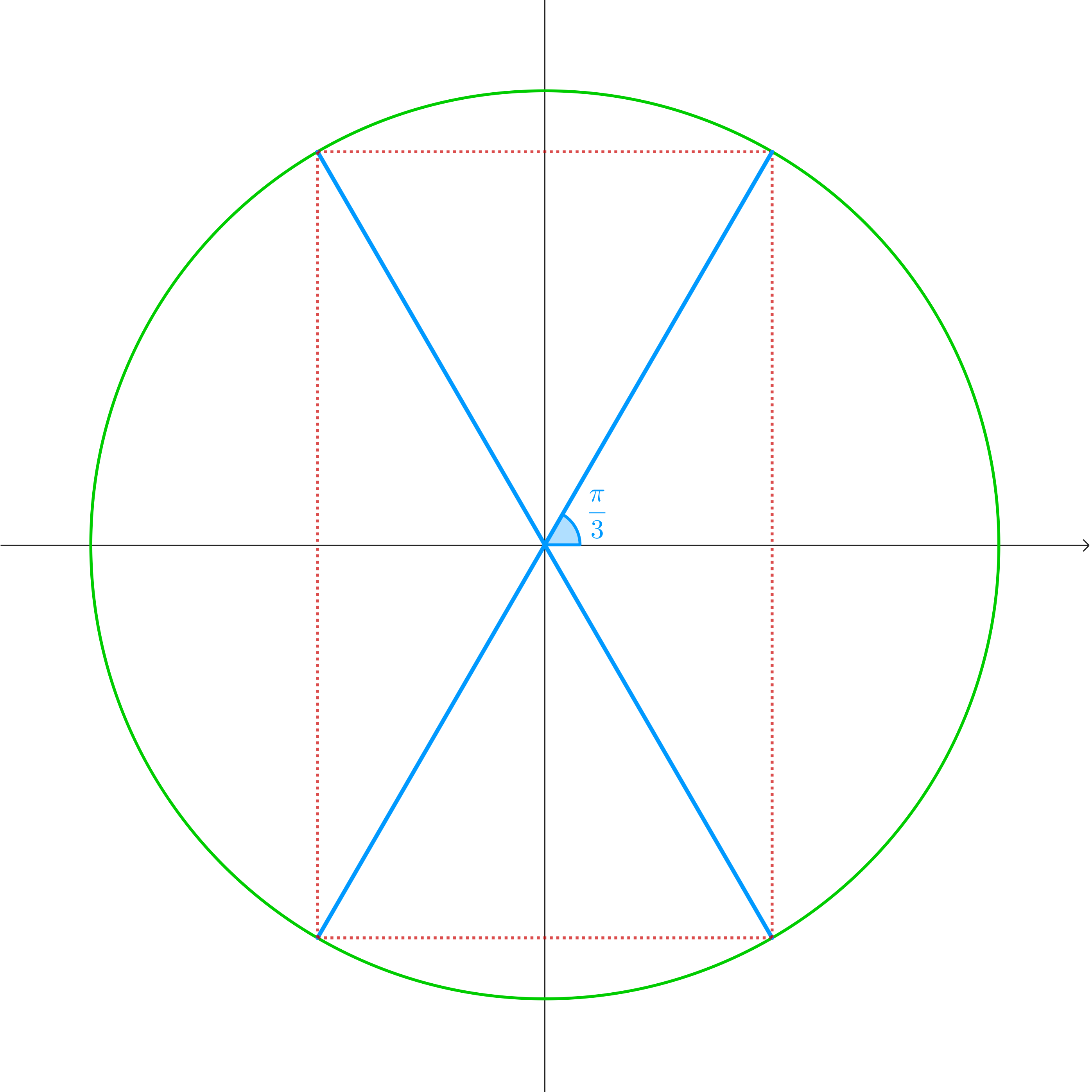
Use this diagram to find the values below (no calculator, of course):

Unit circle diagram

\[\begin{matrix} \sin\displaystyle\frac{\pi}{3} & & & & & & & & & & & & \arcsin\displaystyle\frac{\sqrt{3}}{2} \\ \end{matrix}\]

part a

We'll look at the whole thing from the point of view of graphs.

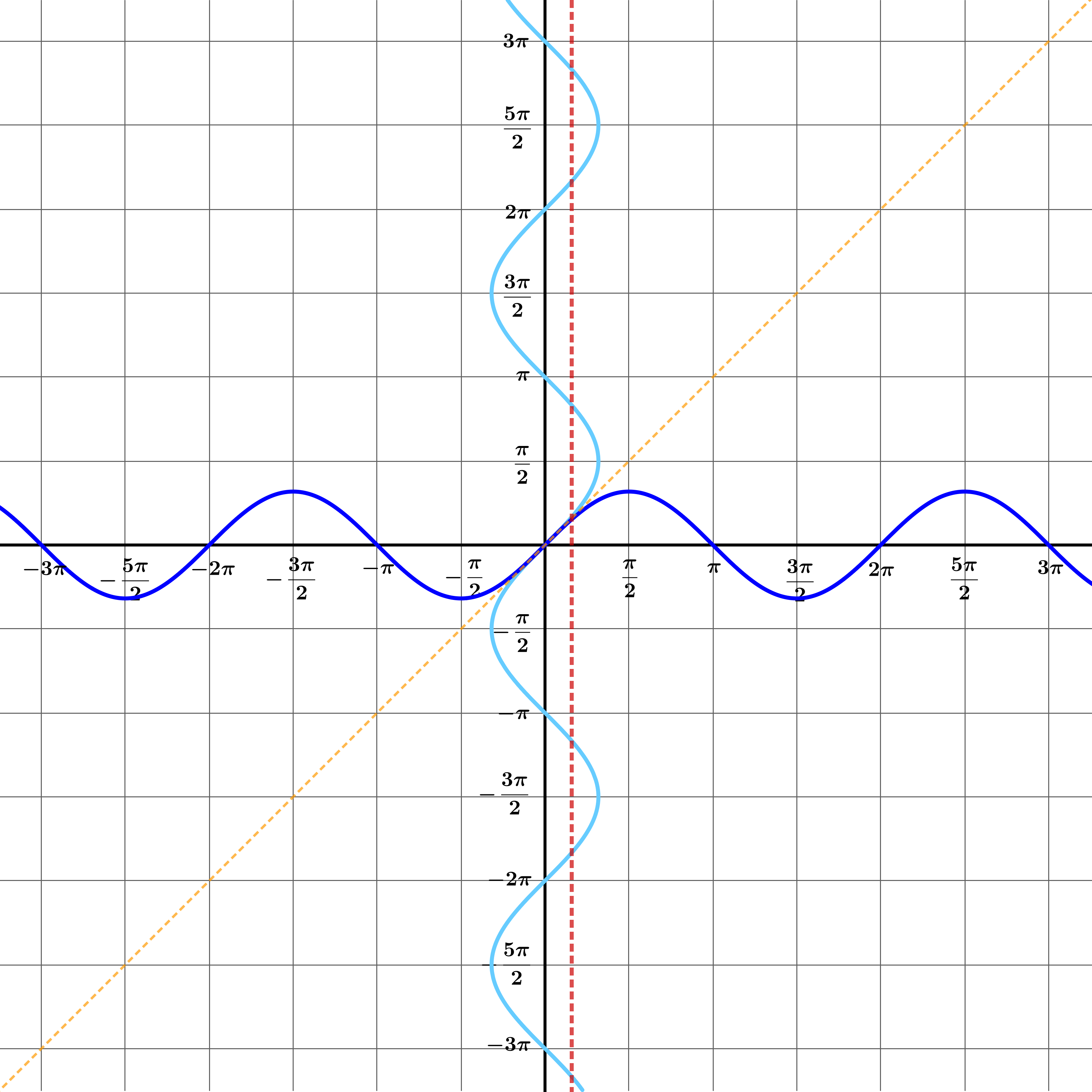
On the same set of axes, draw the graphs \(y=\sin x\) and \(x=\sin y\)
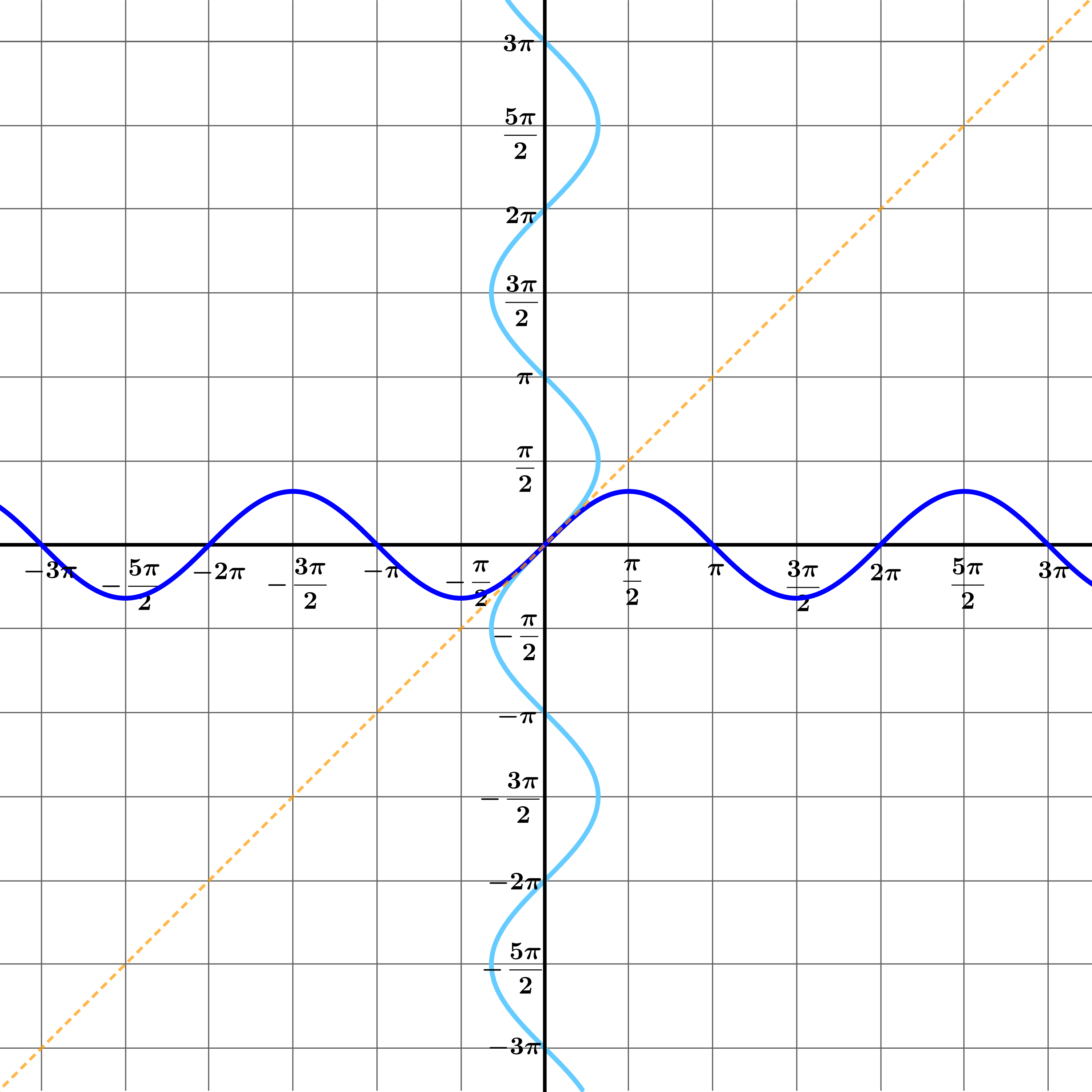
Solve the equation \(\sin y = \frac{1}{2}\) and explain how your answer relates to the graphs.
Graph showing intersections

\(\sin y = \frac{1}{2}\) has solutions

\[y = \frac{\pi}{6},\frac{5\pi}{6},\frac{13\pi}{6},\ldots - \frac{7\pi}{6}, - \frac{11\pi}{6}, - \frac{19\pi}{6},\ldots\]

and these values are where the graphs \(x = \sin y\) and \(x = \frac{1}{2}\) intersect.

How many values do you want for \(\arcsin\frac{1}{2}\) ?

How many times do you want the line \(x = \frac{1}{2}\) to intersect with the graph \(y = \arcsin x\) ?

Like any function, the function \(y = \arcsin x\) must be well-defined (that is, uniquely defined) for all values of \(x\) in its domain.

That means that the line \(x = \frac{1}{2}\) must intersect with the graph \(y = \arcsin x\) exactly once.

How many values do you want for \(\arcsin a\) for any value of \(a\) between \(-1\) and \(1\)?

How many times do you want the line \(x = a \) for any value of \(a\) between \(-1\) and \(1\) to intersect with the graph \(y = \arcsin x\) ?

Like any function, the function \(y = \arcsin x\) must be well-defined (that is, uniquely defined) for all values of \(x\) in its domain.

That means that the line \(x = a\) must intersect with the graph \(y = \arcsin x\) exactly once.

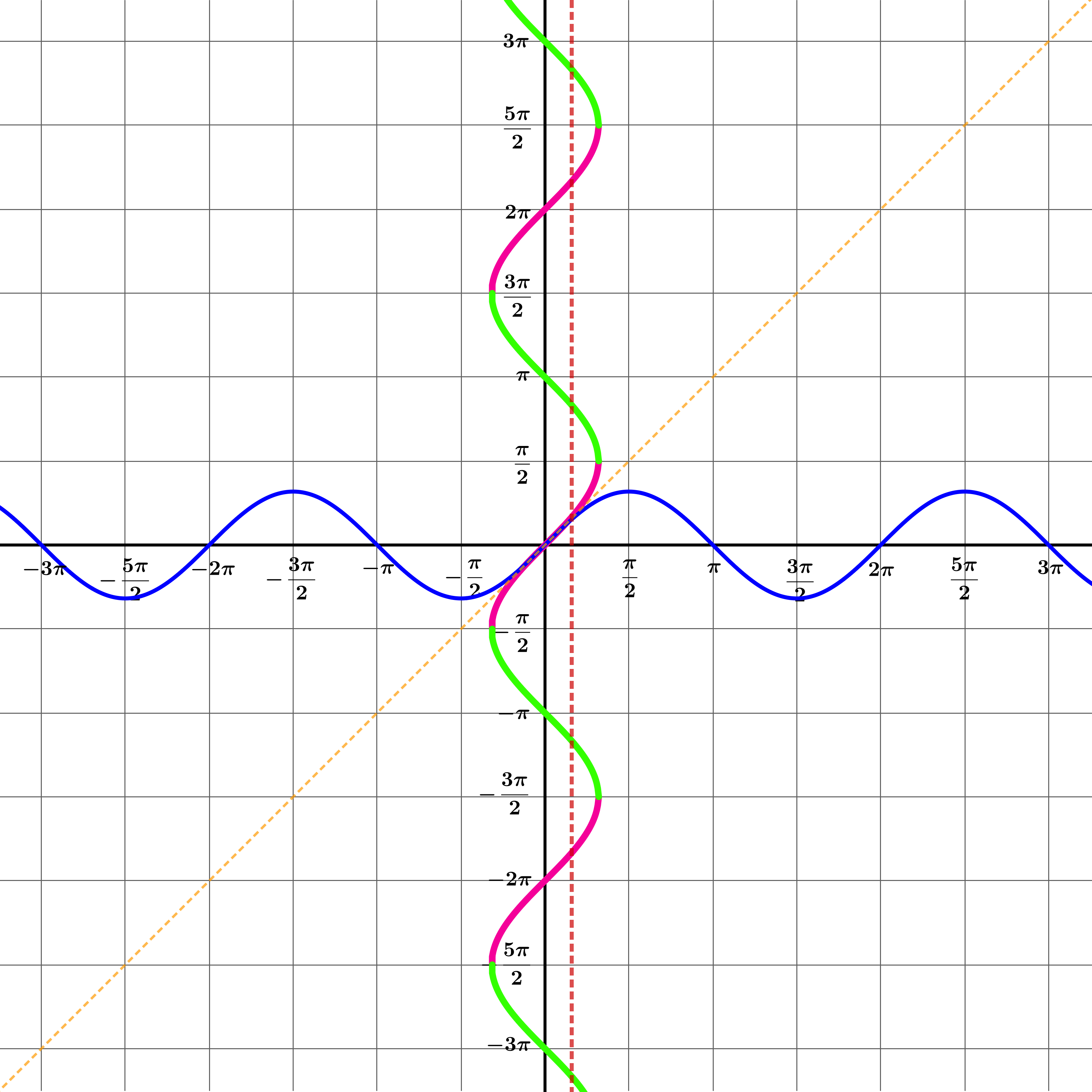
How can you adapt the graph \(x = \sin y\) to ensure that any vertical line between \(x = - 1\) and \(x = 1\) intersects it exactly once?

We need to choose just a small part of the curve \(x = \sin y\), making sure that it is big enough to intersect every vertical line between \(x = - 1\) and \(x = 1\), but small enough to make sure that no such vertical line intersects this section of the curve more than once.

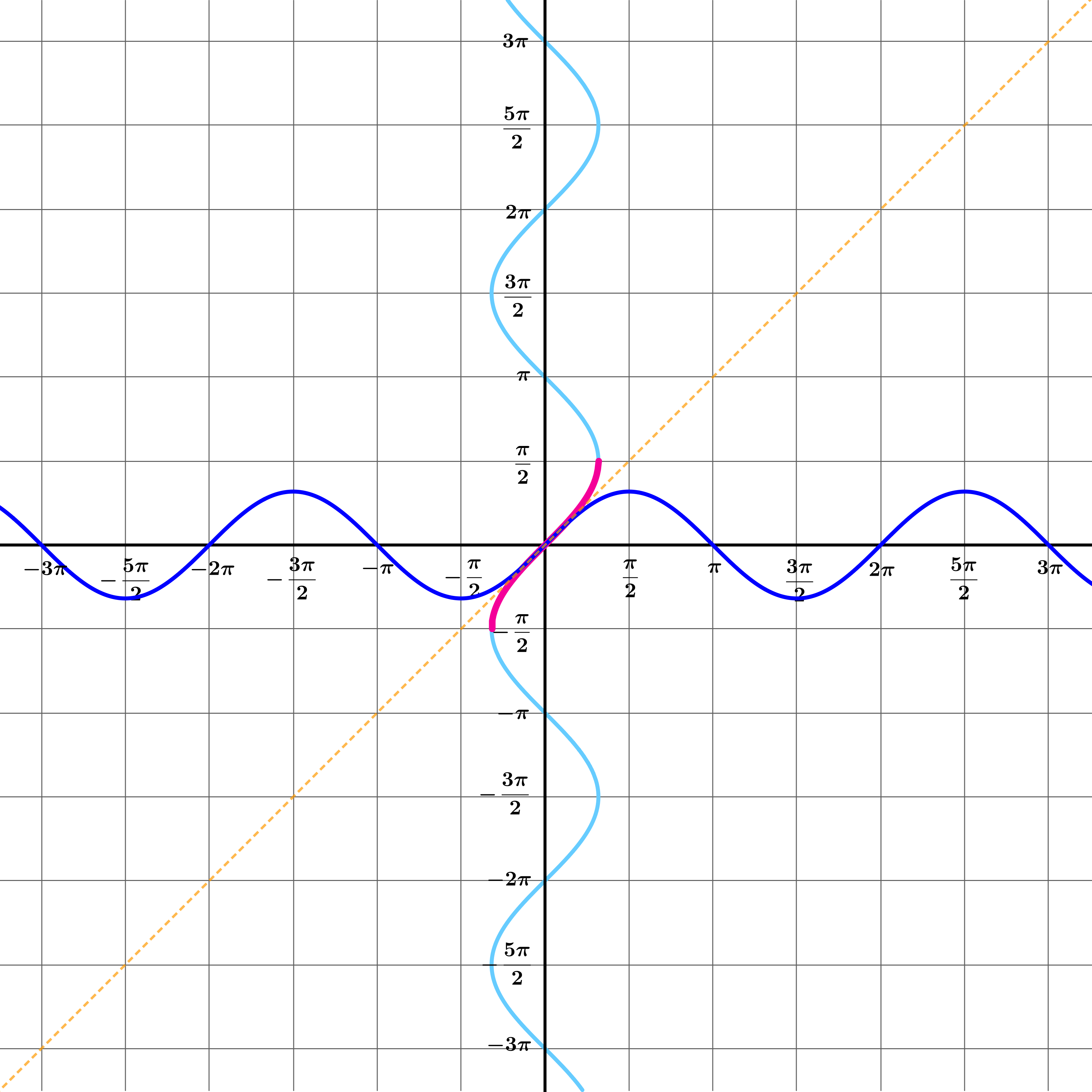
There are many such segments . . . an infinite number, in fact. Some of the possibilities are coloured pink and green in this diagram.
Graph showing segment choices Graph showing selected segment

We could choose any coloured section of the graph \(x = \sin y\), but it would be strange (though not impossible) to choose any segment other than the one that would mean \(\arcsin0 = 0\).

Which of these pink or green segments on the curve would correspond to the most sensible definition of the function \(\arcsin x\) ?

Only the pink segment here is the graph \(y = \arcsin x\).

What are the domain and range of the function \(f(x)=\arcsin x\)?

The easiest way to see this is to look at the graph above:

\(\text{domain}=\big\{x\mid-1\leq x\leq 1\big\}\)

\(\text{range}=\Big\{y\;\Big|\;-\dfrac{\pi}{2}\leq y\leq \dfrac{\pi}{2}\Big\}\)

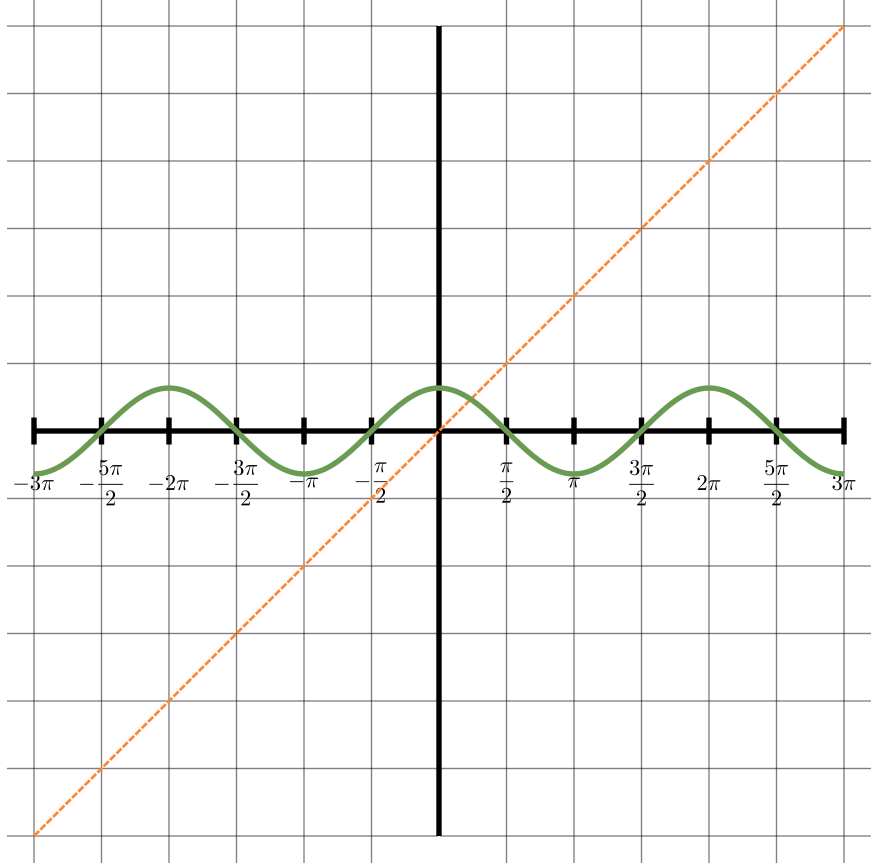
Draw the graph \(y = \cos x\).

On the same axes, draw the graph \(x=\cos y\).
Graphs of x = cos y and y = cos^-1 x

Draw the graph \(y = \cos x\).

On the same axes, draw the graph \(x=\cos y\).

How can we adapt the graph \(x=\cos y\) to get the graph \(y=\arccos x\) ?

How can we adapt the graph \(x=\cos y\) to get the graph \(y=\arccos x\) ?

As before, any of the coloured segments will ensure that the vertical line cuts the graph exactly once at all times.

Which segment shall we choose for the graph \(y=\arccos x\) ?
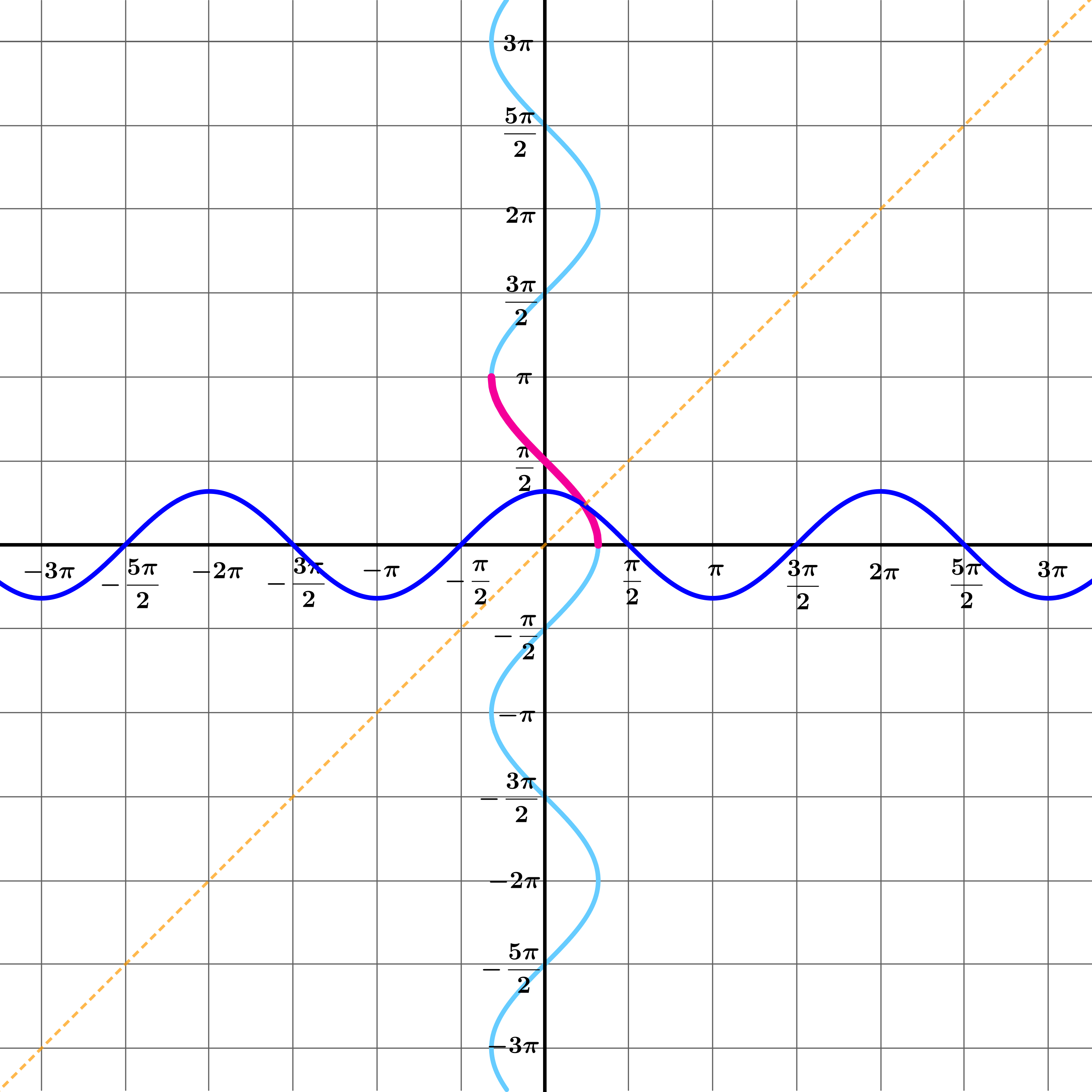
Graph showing different segments

domain:

\[\{ x: - 1 \leq x \leq 1\}\]

range:

\[\left\{ y:0 \leq y \leq \pi \right\}\]
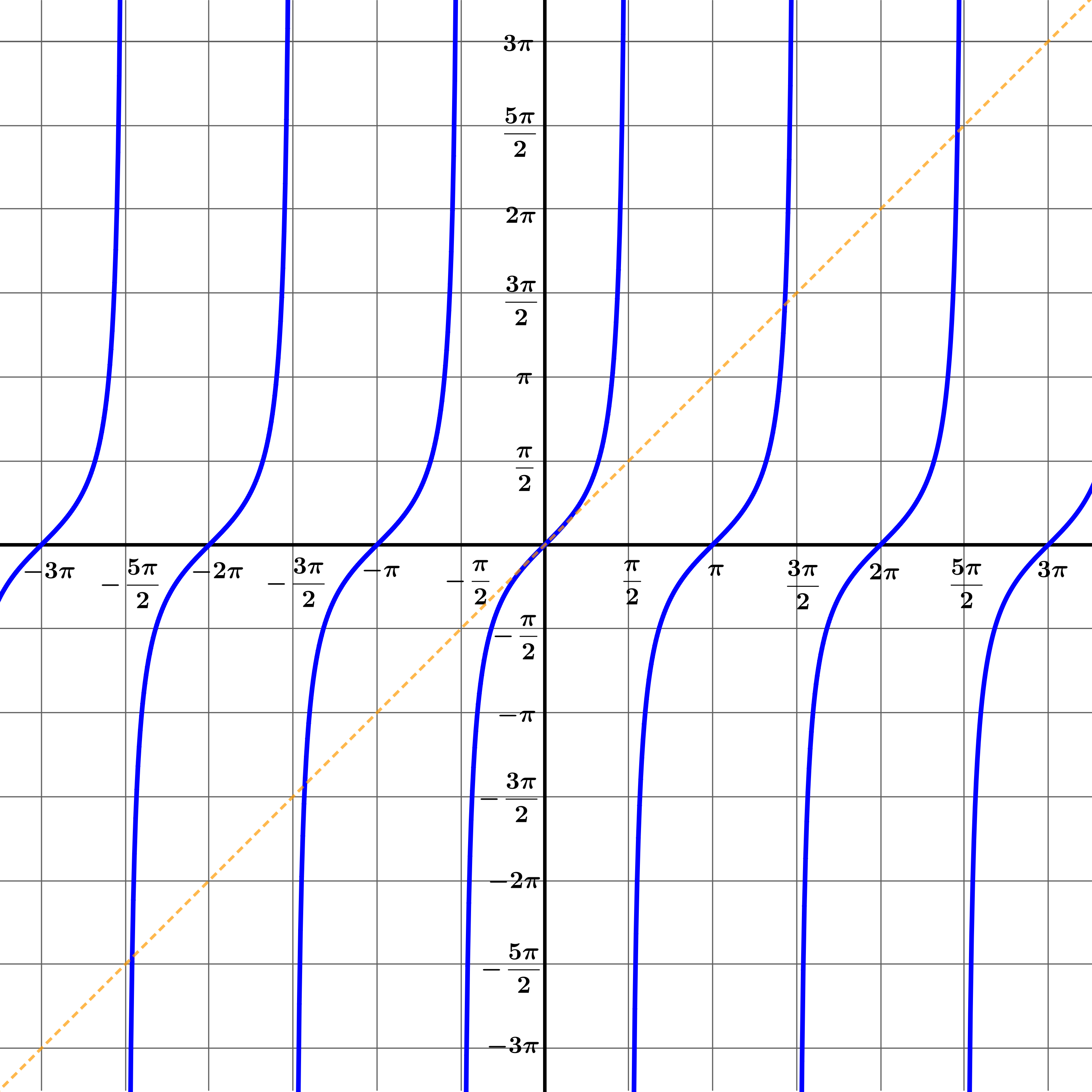
Draw the graphs \(y=\tan x\) and \(x=\tan y\) on the same set of axes.
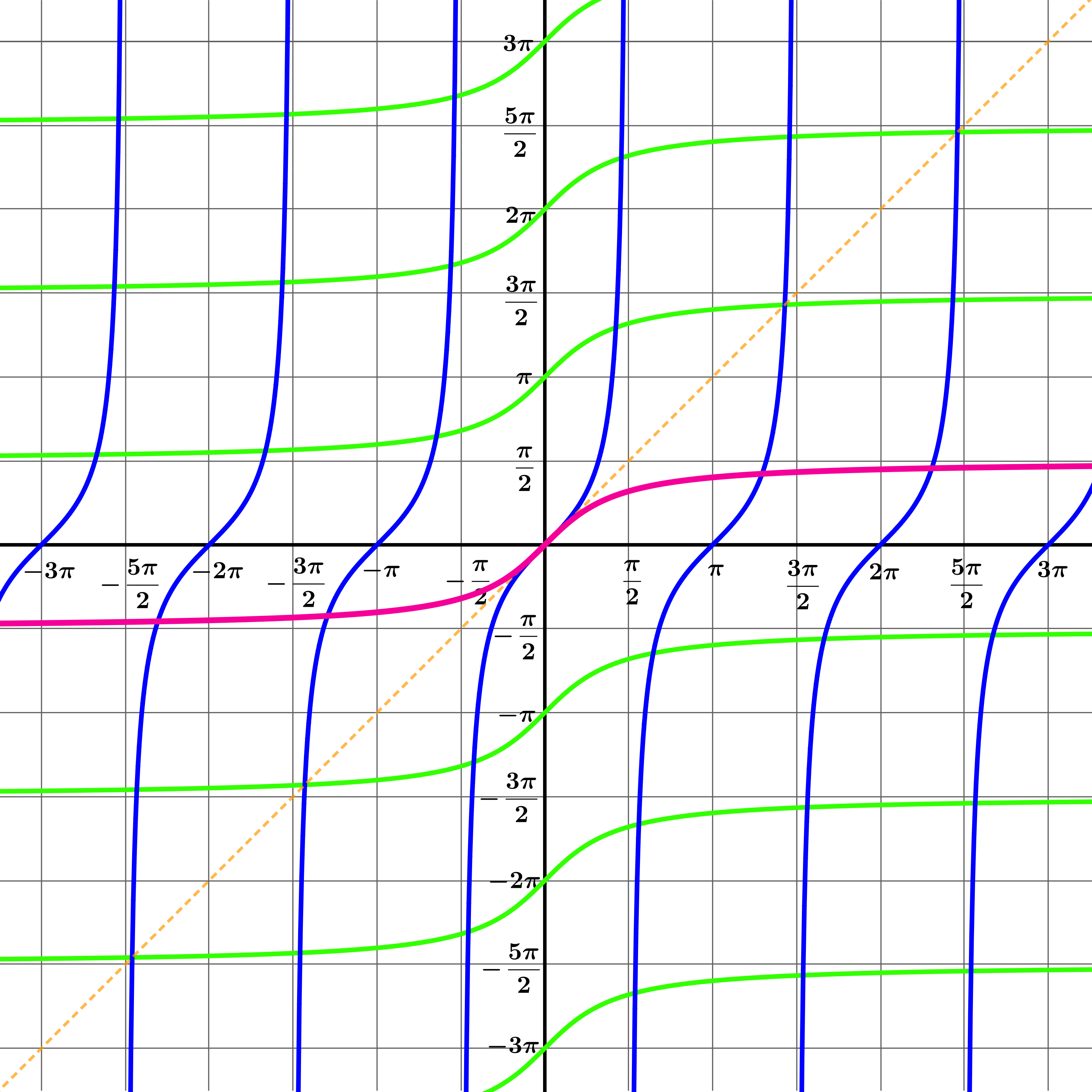
Diagram

Draw the graphs \(y=\tan x\) and \(x=\tan y\) on the same set of axes.

Diagram

What are the domain and range of the function \(y=\arctan x\)?

What are the domain and range of the function \(y=\arctan x\)?

Diagram

The red graph is the graph \(y=\arctan x\), giving

domain:

\[\mathbb{R}\]

range:

\[\left\{ y: - \frac{\pi}{2} < y < \frac{\pi}{2} \right\}\]

Well done on completing Part 1!

You have explored the inverse circular functions in depth — defining arcsin, arccos, and arctan, understanding their domains and ranges, drawing and interpreting their graphs.

Part 2 continues with identities, compositions, and sum formulas.

Dr Brian Brooks
Mathematics InSight

Part 2 →