Welcome to Inverse Circular Functions: Part 2
This stage covers identities such as \(\arcsin x + \arccos x = \frac{\pi}{2}\), compositions of inverse circular functions, and sum formulas for arcsin, arccos, and arctan.
Keep the domain restrictions in mind when working with compositions and identities!
 Dr Brian Brooks
Mathematics InSight
You already know that \(\cos(-x)=\cos x\) and that \(\sin(-x)=-\sin x\).
Let's see what the relationship is between \(\arccos(-x)\) and \(\arccos x\), and between \(\arcsin(-x)\) and \(\arcsin x\).
On the same set of axes, draw the graphs \(y=\arccos x\) and \(y=\arccos(-x)\)
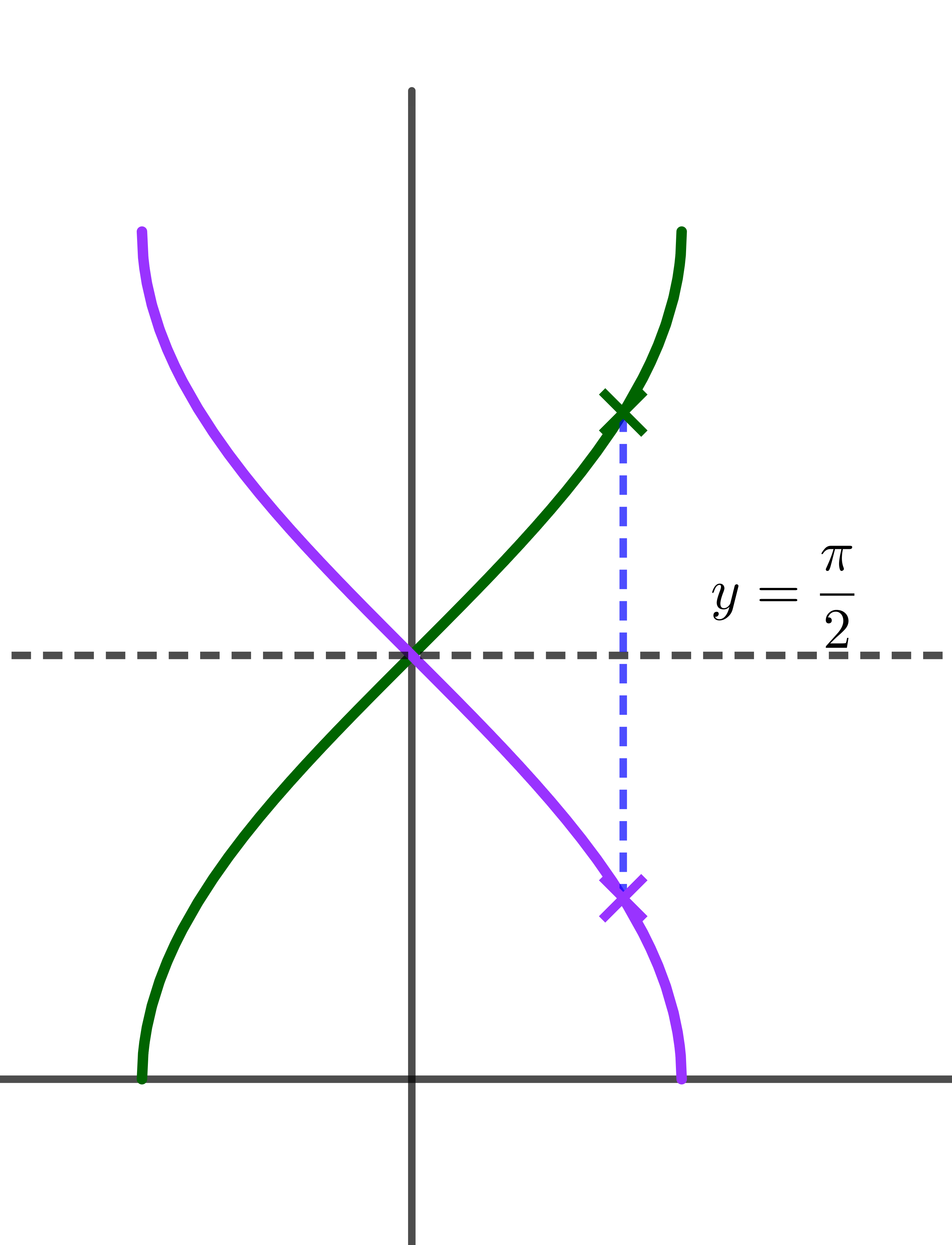
What is \(\arccos x+\arccos(-x)\) ?
The average \(y\) coordinates of the two crosses is \(\displaystyle\frac{\pi}{2}\) so
\[\arccos x+\arccos(-x)=\pi\]On the same set of axes, draw the graphs \(y=\arcsin x\) and \(y=\arcsin(-x)\)
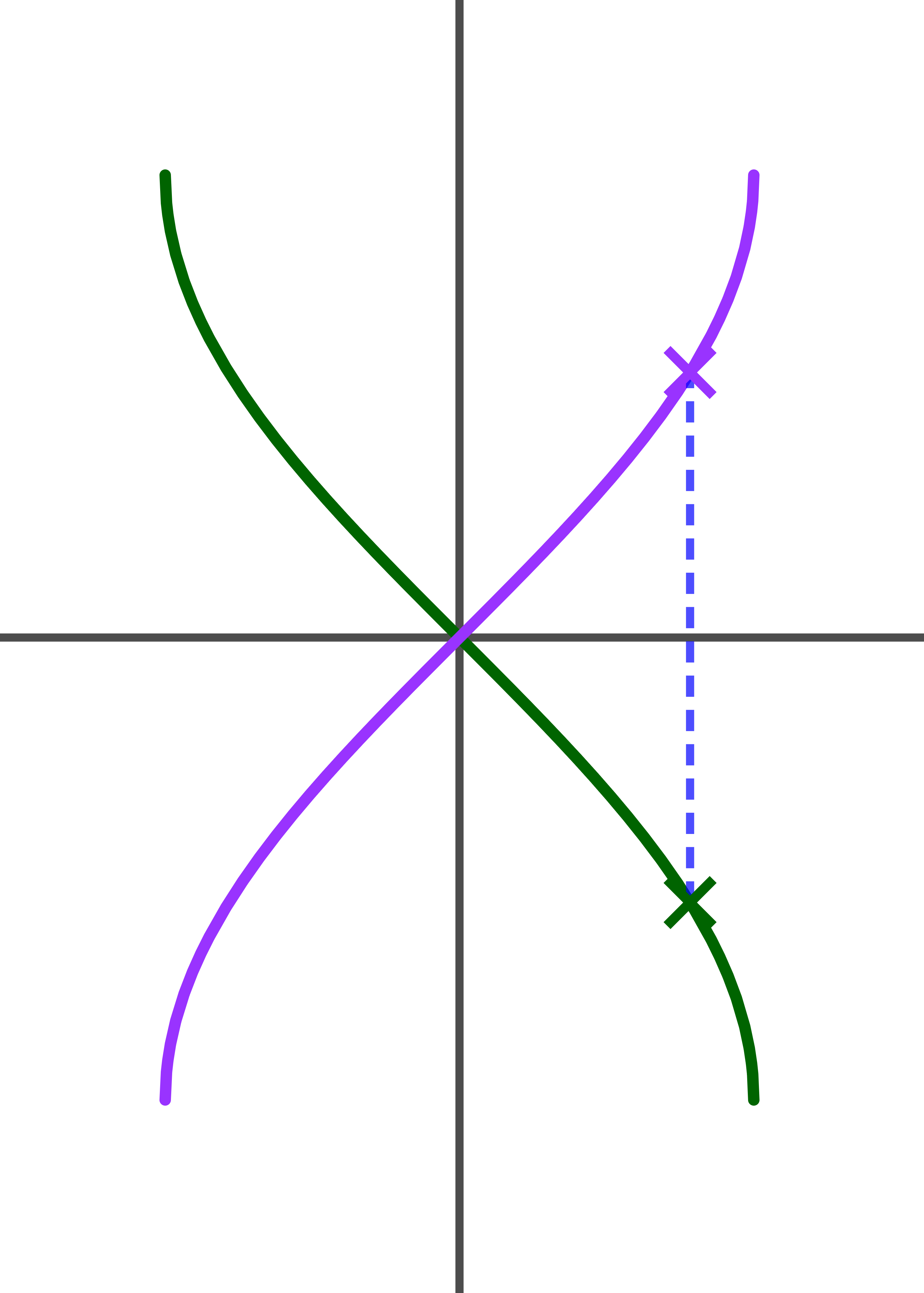
What is \(\arcsin x+\arcsin(-x)\) ?
The average \(y\) coordinates of the two crosses is \(0\) so
\[\arcsin x+\arcsin(-x)=0\]On the same set of axes, draw the graphs \(y=\arctan x\) and \(y=\arctan(-x)\)
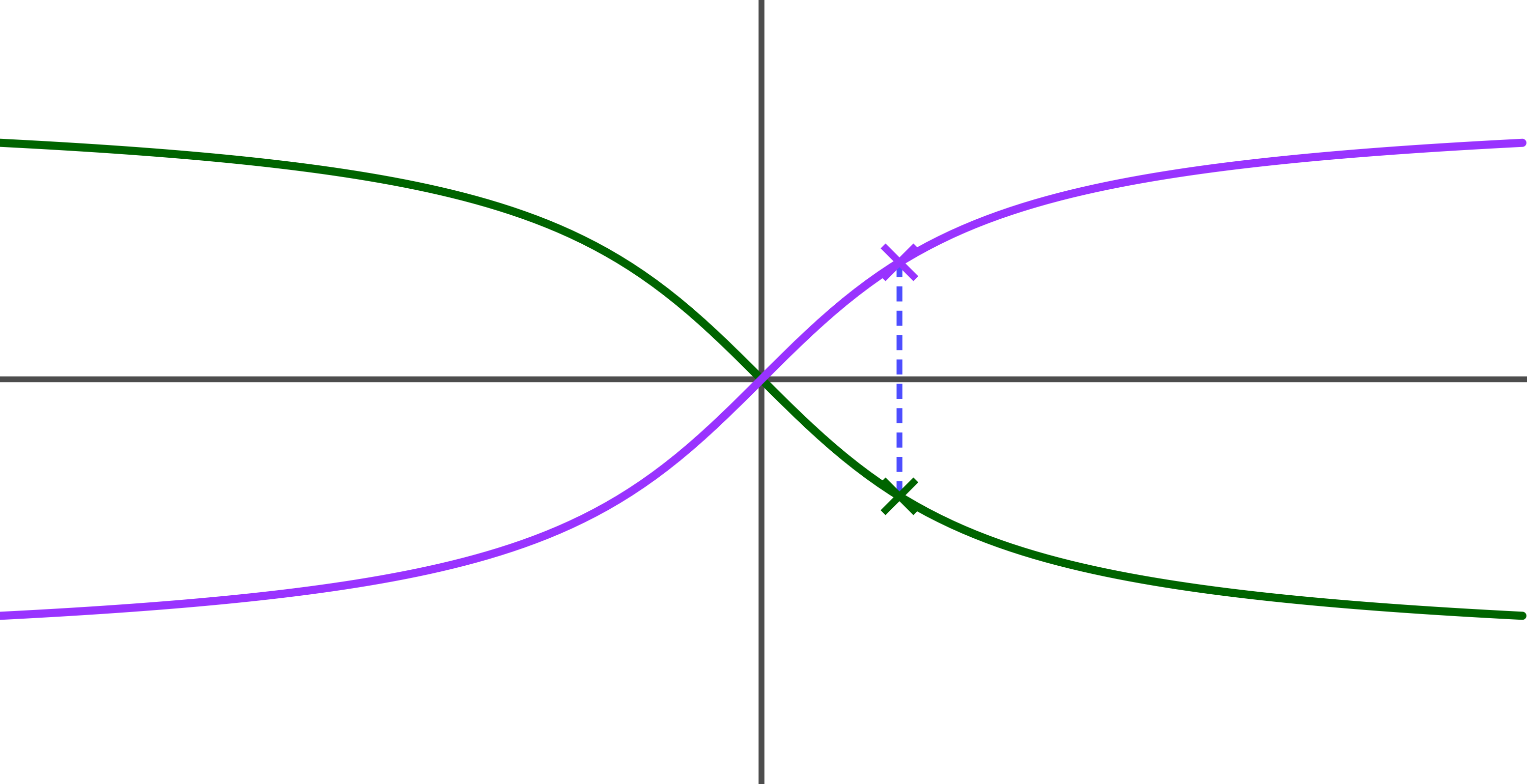
What is \(\arctan x+\arctan(-x)\) ?
The average \(y\) coordinates of the two crosses is \(0\) so
\[\arctan x+\arctan(-x)=0\]Next, I want to show you a generalization of the fact that angles in a triangle add up to \(180^\circ\) using arcsin and arccos functions.
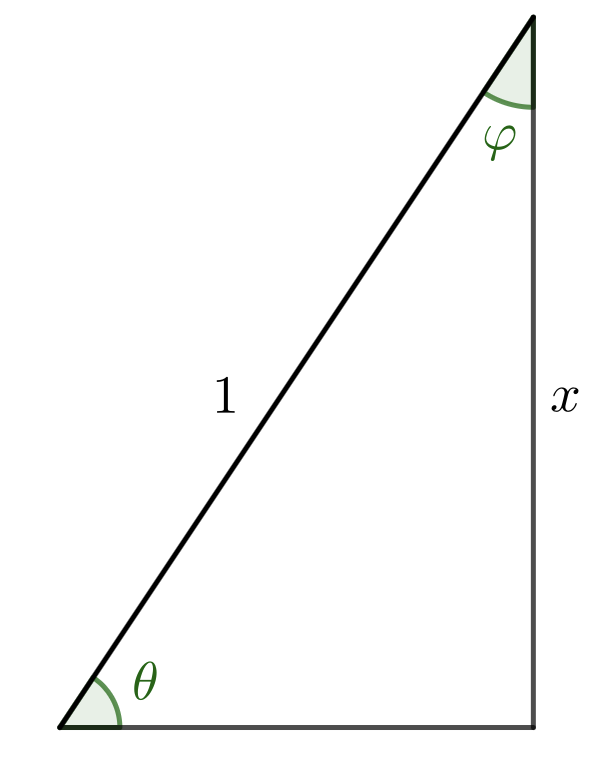
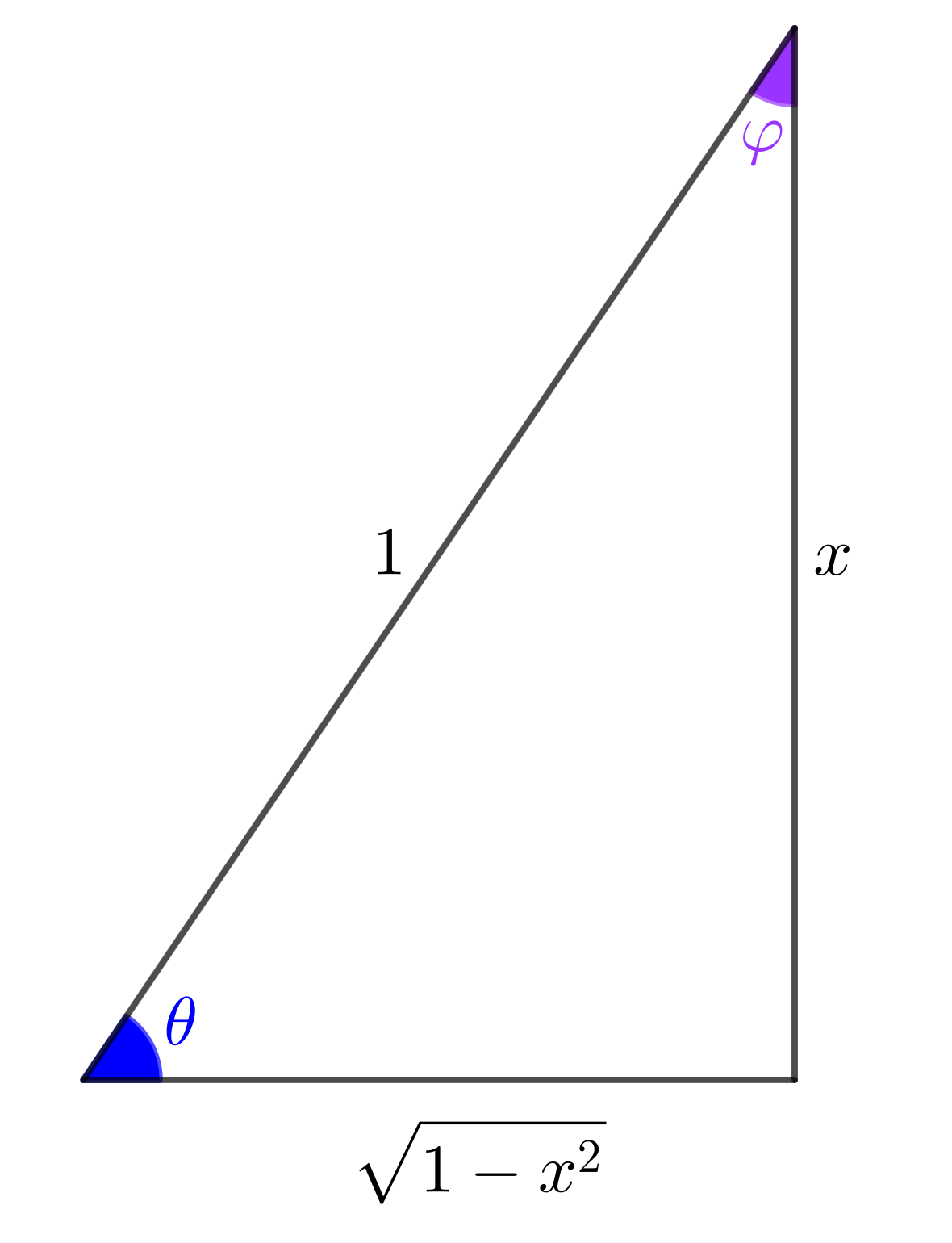
\(\arcsin x + \arccos x = \theta + \varphi = \displaystyle{\frac{\pi}{2}}\) when \(x\) is positive.
When \(x\) is positive, we can easily see this from the right-angled triangle. The triangle doesn't really help so much for negative values of \(x\), but we can use the identities from the start of this journey or we can look at graphs for this.
On the same set of axes, draw the graphs \(y = \arcsin x\) and \(y = \arccos x\)
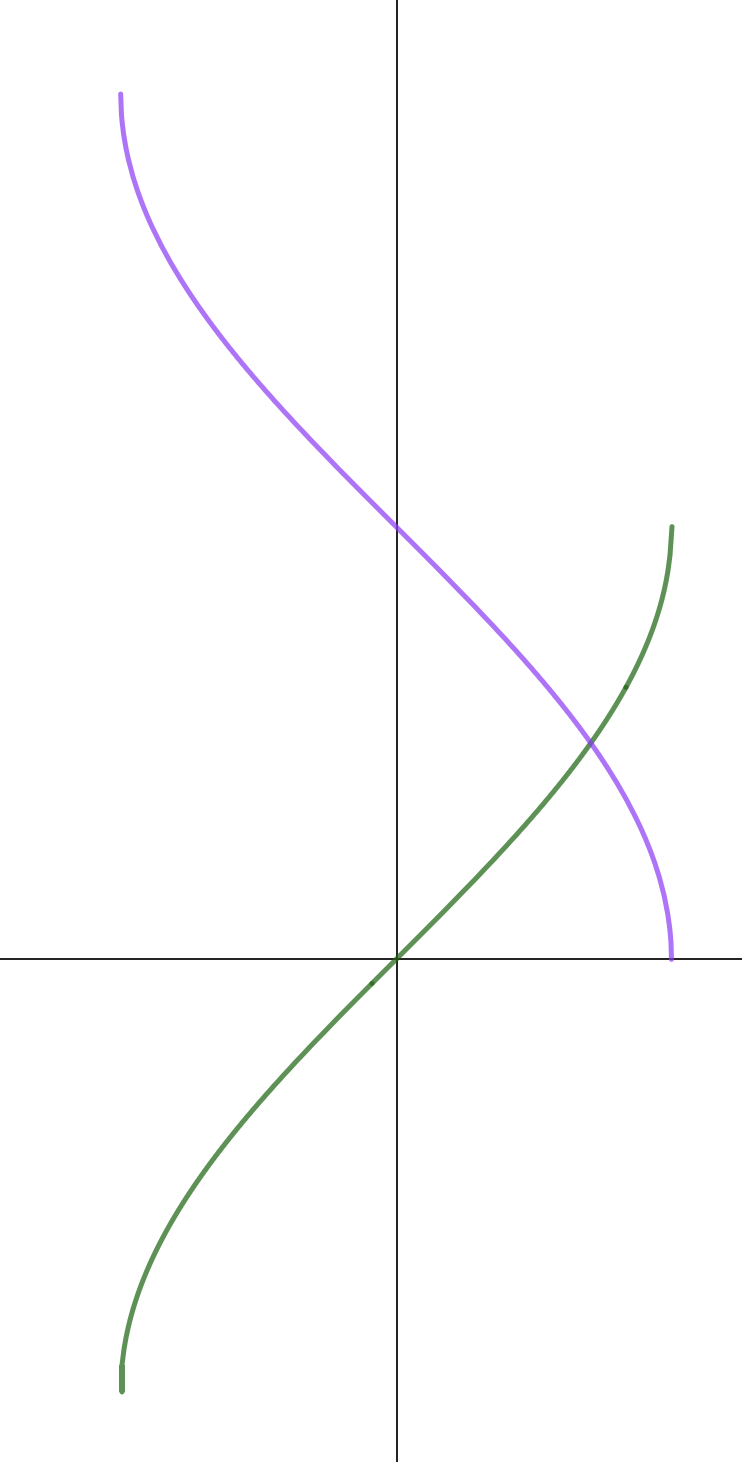
Where do they cross?
They cross at \(\displaystyle{\left( \frac{\sqrt{2}}{2},\frac{\pi}{4}\right)}\).
The easiest way to see this is by looking at the symmetry of the diagram.
Alternatively, note that \[\sin y = \cos y \Rightarrow \tan y = 1 \Rightarrow y = \frac{\pi}{4}\].
What is the average of the \(y\) coordinates of the pink and green points?
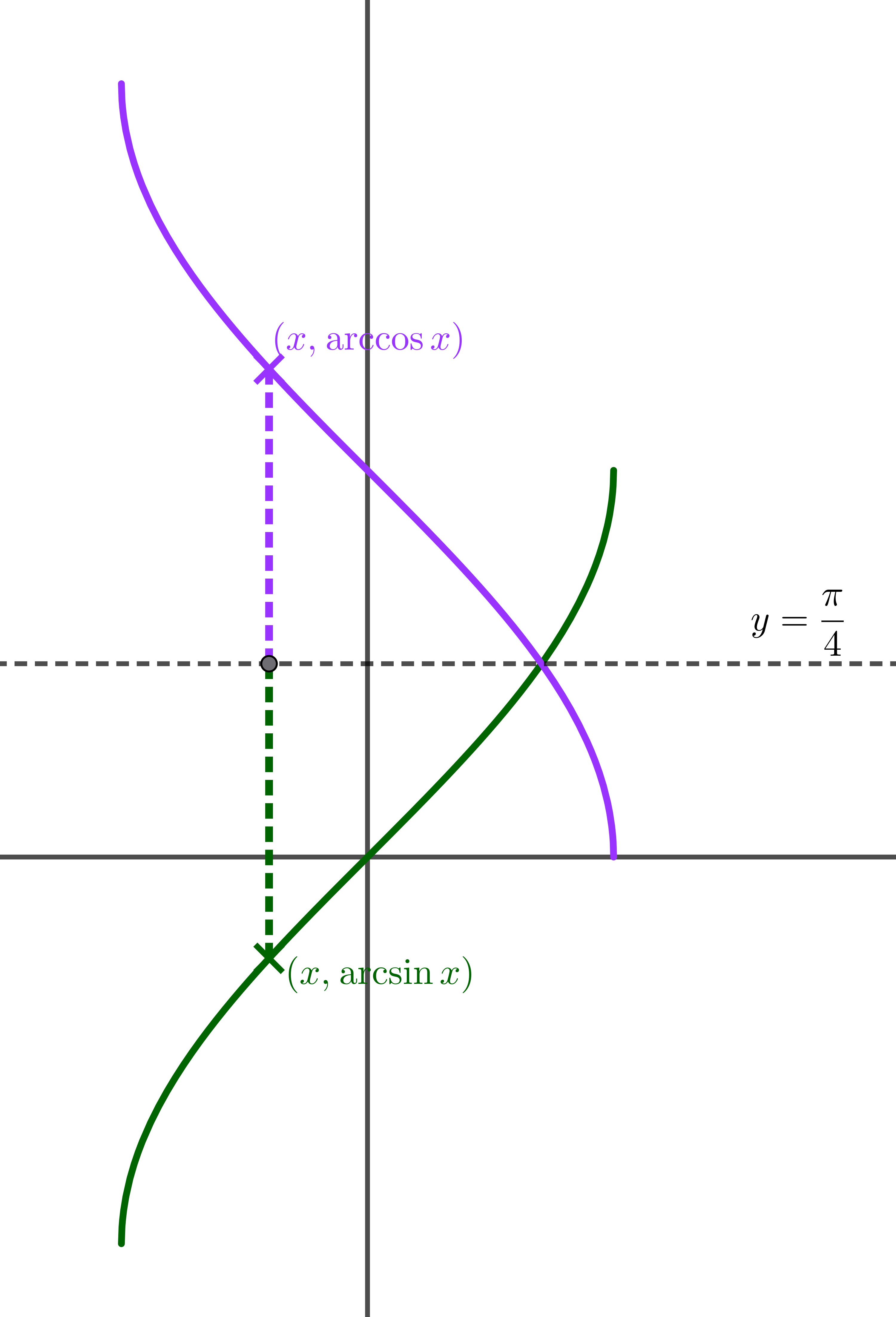
Symmetry means that the average is \(\displaystyle{\frac{\pi}{4}}\).
Now find \(\arccos x+\arcsin x\).
If their average is \(\displaystyle{\frac{\pi}{4}}\) then their total is \(\displaystyle{\frac{\pi}{2}}\), so that for any value of \(x\), \[\arccos x+\arcsin x=\frac{\pi}{2}\]
Use the identities
\[\arccos x+\arccos(-x)=\pi\] \[\arcsin x+\arcsin(-x)=0\]to find \(\arcsin x+\arccos x\) when \(x<0\).
Next, let's see what happens when we combine circular functions with their inverses.
Find
\[\begin{aligned} &\cos\left(\arcsin \frac{1}{2}\right)\\[6pt] &\cos\left(\arcsin \left(-\frac{1}{2}\right)\right)\\[6pt] &\sin\left(\arccos \frac{1}{2}\right)\\[6pt] &\sin\left(\arccos \left(-\frac{1}{2}\right)\right) \end{aligned}\]We've seen what happens with some values. Now let's generalize.
Find \(\cos(\arcsin x)\) when \(x\) is positive.
Find \(\sin(\arccos x)\) when \(x\) is positive.
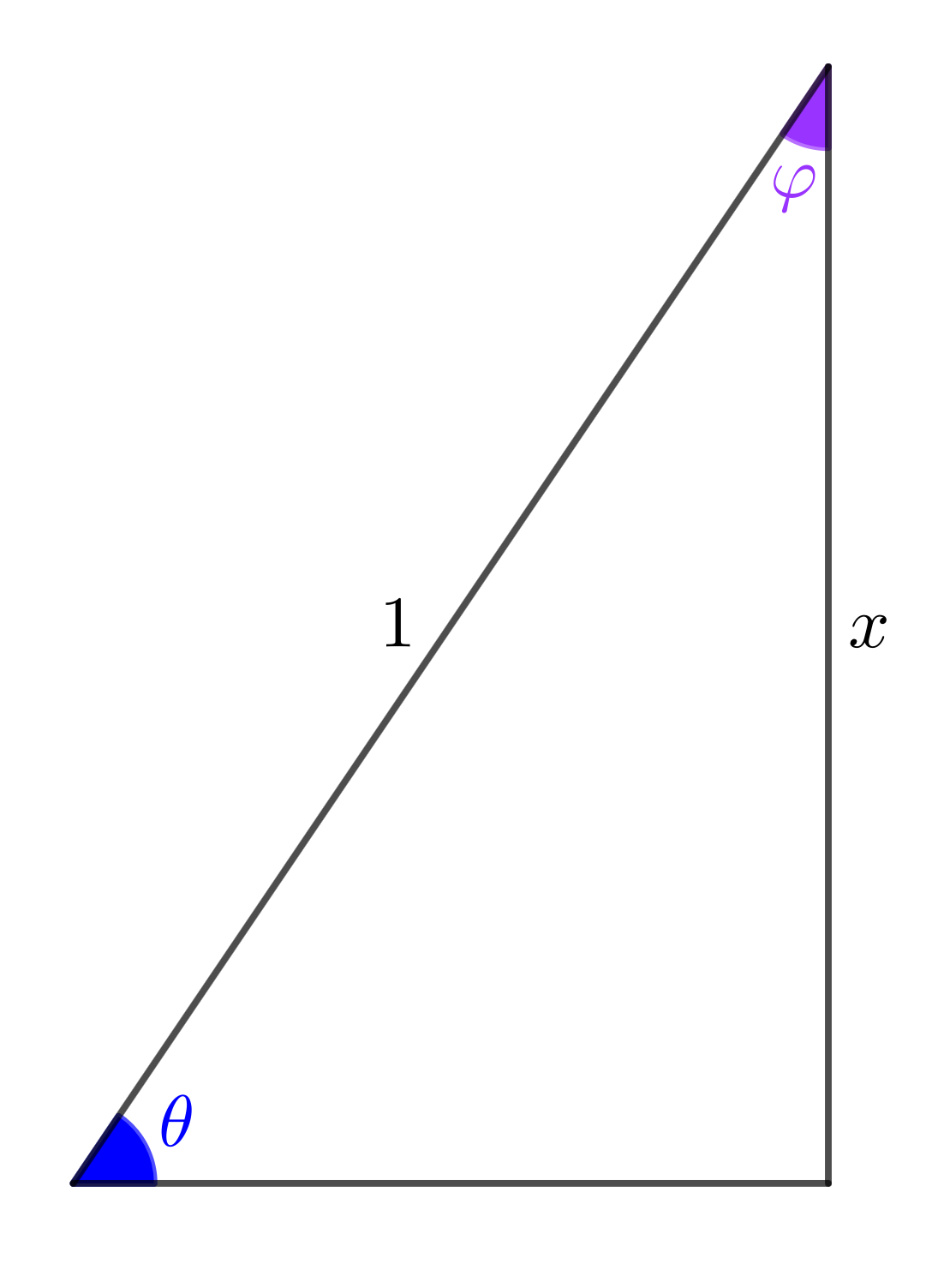
From the diagram
\[\begin{aligned} &x>0\Rightarrow\cos(\arcsin x) = \cos\theta=\sqrt{1-x^2}\\[6pt] &x>0\Rightarrow\sin(\arccos x) = \cos\varphi=\sqrt{1-x^2}\\ \end{aligned}\]Remembering that \[\begin{aligned} &\arcsin x+\arcsin(-x)=0 \text{ and}\\[6pt] &\arccos x+\arccos(-x)=\pi \end{aligned}\]
find \(\cos(\arcsin x)\) and \(\sin(\arccos x)\) when \(x\) is negative.
Another way to write this is:
\[\begin{align*} &x^2+\cos^2(\arcsin x)=1\\[12pt] &x^2+\sin^2(\arccos x)=1 \end{align*}\]Draw the graph \(y=\sin(\arccos x)\)
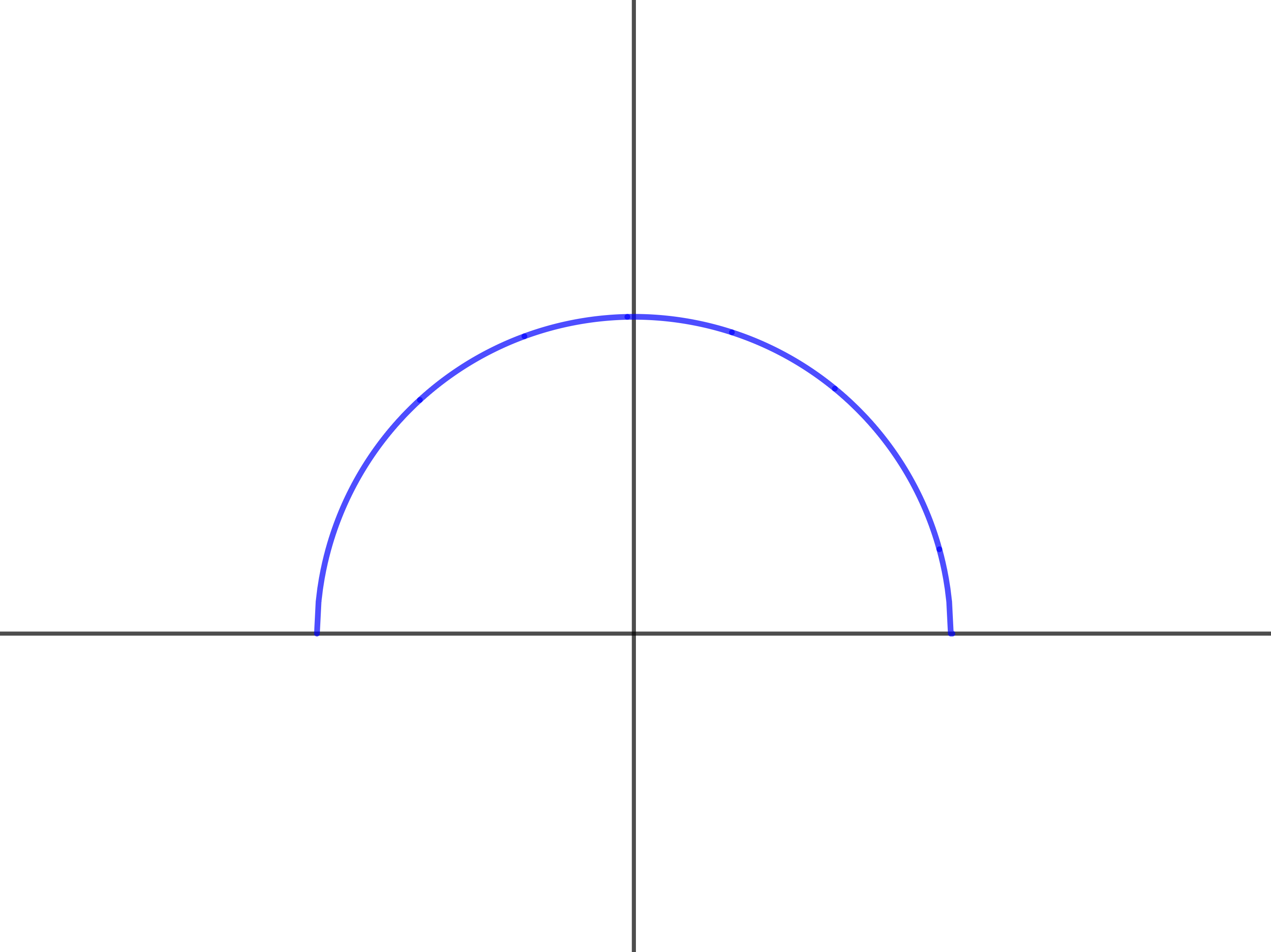
Use the fact that \((x,\,y)=(\cos\theta,\,\sin\theta)\) lies on the unit circle to explain why the point \((x,\,\sin(\arccos x))\) lies on the unit circle.
\((x,\,y)=(\sin\varphi, \,\cos\varphi)\) also lies on the unit circle, so
\[\begin{align*} x^2+y^2=1\text{ and }\theta=\arcsin x\\[12pt] \Rightarrow\,x^2+\cos^2(\arcsin x)=1 \end{align*}\]Find
\[\begin{aligned} &\arccos\left(\sin \frac{\pi}{6}\right)\\[6pt] &\arccos\left(\sin \left(-\frac{\pi}{6}\right)\right)\\[6pt] &\arccos\left(\sin \frac{5\pi}{6}\right)\\[6pt] &\arccos\left(\sin \left(-\frac{5\pi}{6}\right)\right) \end{aligned}\]Find \(\arccos(\sin\theta)\) and \(\arcsin(\cos\varphi)\)in terms of \(\theta\) or \(\varphi\) when \(0\le\theta, \varphi\le\frac{\pi}{2}\)
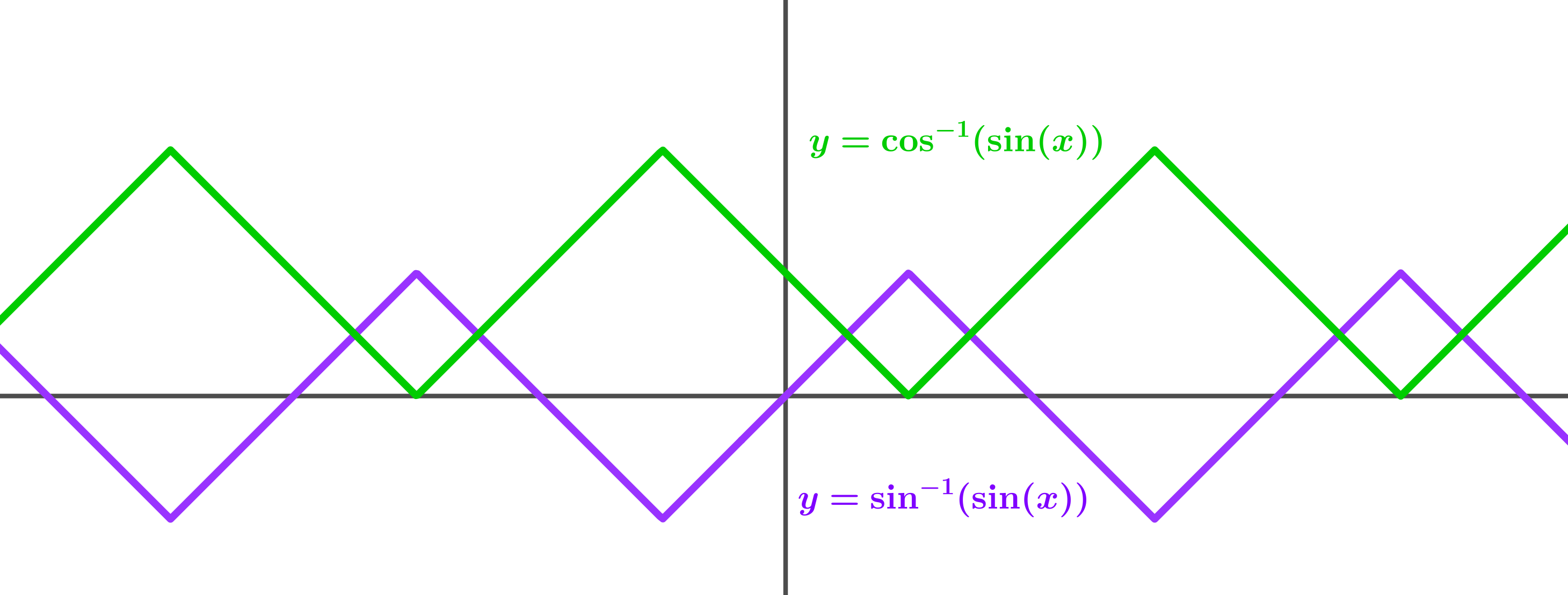
For other values of \(\theta\), we still have \(\arccos(\sin\theta)+\arcsin(\sin\theta)=\displaystyle{\frac{\pi}{2}}\).
On the same set of axes, draw the graphs \(y=\arcsin(\sin x)\) and \(y=\arccos(\sin x)\).
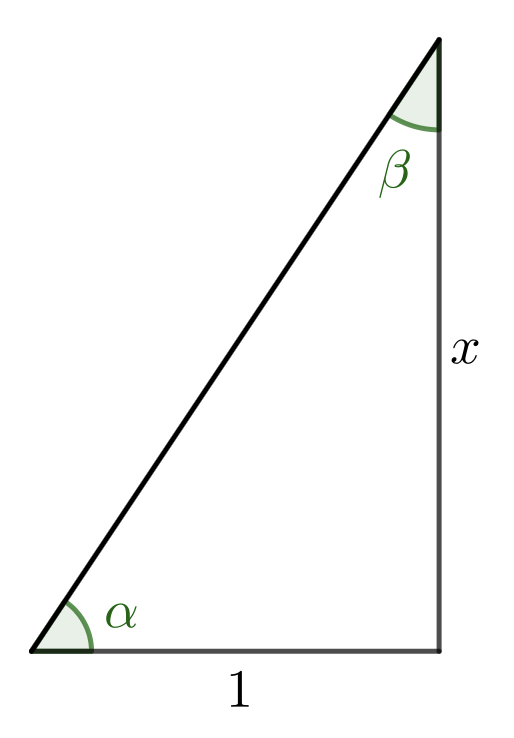
Find \(\tan(\arcsin x)\) and \(\tan(\arccos x)\).
Find \(\sin(\arctan x)\) and \(\cos(\arctan x)\).
Using the fact that
\[\sin(A + B) = \sin A\cos B + \cos A\sin B\]and putting \(A = \arcsin a\) and \(B = \arcsin b\), find \(\sin\left(\arcsin a + \arcsin b\right)\) in terms of \(a\) and \(b\), without using \(\sin\) or \(\cos\) in your expression.
Hence find \(\arcsin a + \arcsin b\).
although this isn't quite right if \(\arcsin a+\arcsin b\gt\frac{\pi}{2}\) or \(\le-\frac{\pi}{2}\)
In these cases, we have \[\arcsin a + \arcsin b=\pm\pi- \arcsin\left(a\sqrt{1 - b^{2}} + b\sqrt{1 - a^{2}}\right)\]
Find \(\cos\left(\arcsin a + \arcsin b\right)\) and hence \(\arccos a + \arccos b\).
Putting \(c=\cos A\) and \(d=\cos B\), find \(\cos (A+B)\) and hence find \(\arccos c + \arccos d\).
Putting \(u=\tan A\) and \(v=\tan B\), find \(\tan (A+B)\) and hence find \(\arctan u + \arctan v\).
Well done on completing Part 2!
You have explored identities, compositions, and sum formulas for the inverse circular functions — including the beautiful result that \(\arcsin x + \arccos x = \frac{\pi}{2}\).
Part 3 continues with derivatives and integrals of the inverse circular functions.
Dr Brian Brooks
Mathematics InSight