Welcome to Inverse Circular Functions: Part 3

This stage covers the use of inverse circular functions to evaluate integrals.

Pay close attention to the substitution technique — it unlocks both derivatives and integrals!

Dr Brian Brooks
Mathematics InSight

integrals using inverse circular functions
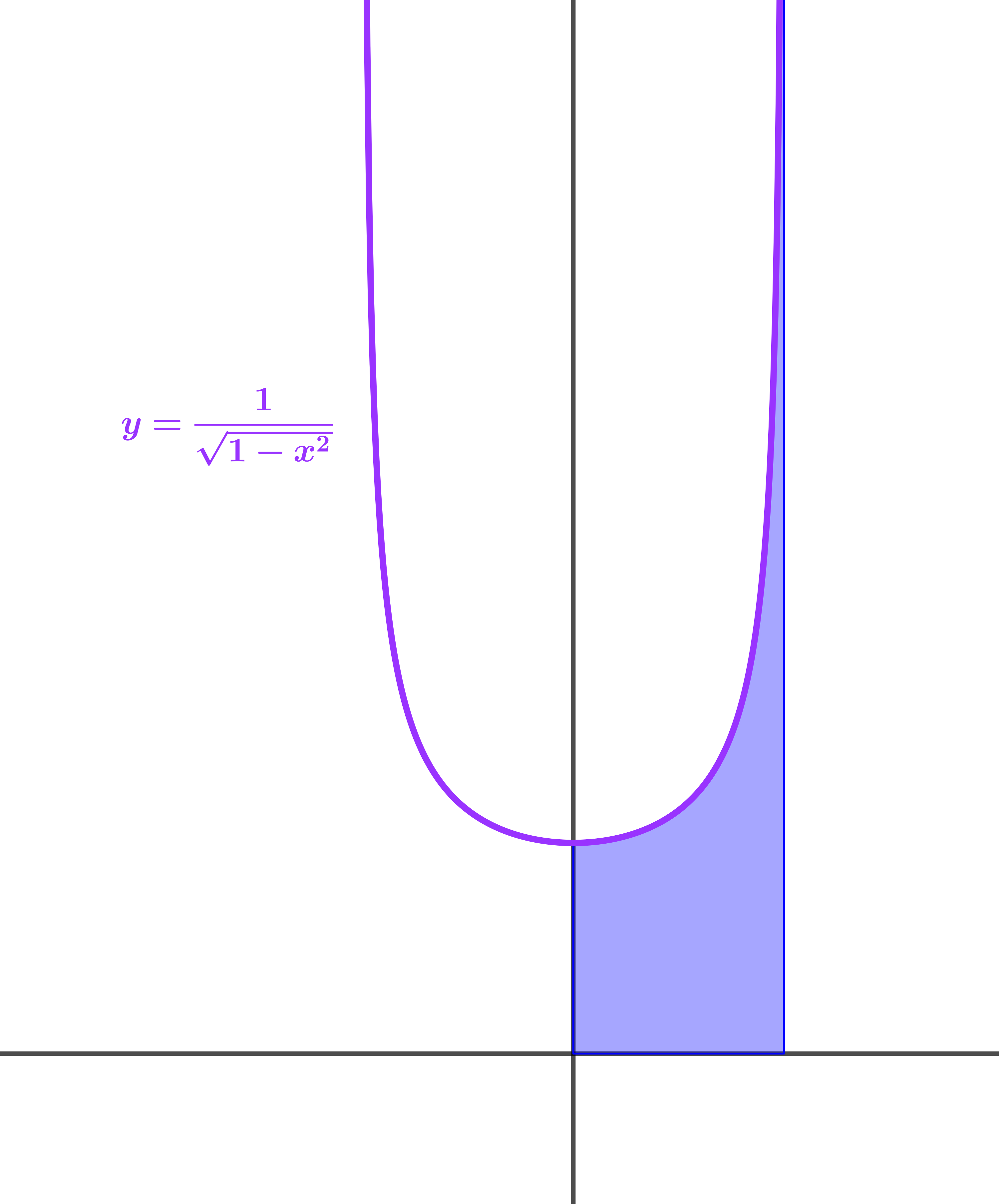
Find the shaded area.

\[\begin{aligned}\frac{\mathrm{d}}{\mathrm{d}x}\arcsin x&=\frac{1}{\sqrt{1-x^2}}\end{aligned}\]
\[\begin{aligned}\Rightarrow\, \int \frac{1}{\sqrt{1-x^2}}\;\mathrm{d}x&=\arcsin x+c\end{aligned}\]
\[\begin{aligned}\Rightarrow\,\text{area}&=\int_0^1 \frac{1}{\sqrt{1-x^2}}\;\mathrm{d}x\end{aligned}\]
\[\begin{aligned}\phantom{\Rightarrow\,\text{area}}&=\bigg[\arcsin x\bigg]_0^1\end{aligned}\]
\[\begin{aligned}\phantom{\Rightarrow\,\text{area}}&=\frac{\pi}{2}\end{aligned}\]

Use the substitution \(\displaystyle{u = \arcsin x}\) for the integral \[\int \frac{1}{\sqrt{1-x^2}}\;\mathrm{d}x\]

\[\begin{aligned}u = \arcsin x \Rightarrow\, \frac{\mathrm{d}u}{\mathrm{d}x} &= \frac{1}{\sqrt{1 - x^{2}}}\end{aligned}\]
\[\begin{aligned}\int\frac{1}{\sqrt{1 - x^{2}}}\;\mathrm{d}x &= \int\frac{1}{\sqrt{1 - x^{2}}}\,\frac{\mathrm{d}x}{\mathrm{d}u}\mathrm{d}u\end{aligned}\]
\[\begin{aligned}\phantom{\int\frac{1}{\sqrt{1 - x^{2}}}\;\mathrm{d}x} &= \int\frac{1}{\sqrt{1 - x^{2}}}\sqrt{1 - x^{2}}\;\mathrm{d}u\end{aligned}\]
\[\begin{aligned}\phantom{\int\frac{1}{\sqrt{1 - x^{2}}}\;\mathrm{d}x} &= \int \mathrm{d}u\end{aligned}\]
\[\begin{aligned}\phantom{\int\frac{1}{\sqrt{1 - x^{2}}}\;\mathrm{d}x} &= u + c\end{aligned}\]
\[\begin{aligned}\phantom{\int\frac{1}{\sqrt{1 - x^{2}}}\;\mathrm{d}x} &= \arcsin x + c\end{aligned}\]

In practice, you might write the subsitution as \(\displaystyle{x=\sin u}\). Try it this way.

\[\begin{aligned}x = \sin u \Rightarrow\, \frac{\mathrm{d}x}{\mathrm{d}u} &= \cos u\end{aligned}\]
\[\begin{aligned}\phantom{x = \sin u \Rightarrow\, \frac{\mathrm{d}x}{\mathrm{d}u}} &= \pm \sqrt{1 - \sin^{2}u}\end{aligned}\]
\[\begin{aligned}\phantom{x = \sin u \Rightarrow\, \frac{\mathrm{d}x}{\mathrm{d}u}} &= \pm \sqrt{1 - x^{2}}\end{aligned}\]

At this point, it is really important to remember that the actual substitution is \(\displaystyle{u=\arcsin x}\) so that \(\displaystyle{\frac{\mathrm{d}x}{\mathrm{d}u}>0}\)

\[\begin{aligned}\int\frac{1}{\sqrt{1 - x^{2}}}\;\mathrm{d}x &= \int\frac{1}{\sqrt{1 - x^{2}}}\;\frac{\mathrm{d}x}{\mathrm{d}u}\mathrm{d}u\end{aligned}\]
\[\begin{aligned}\phantom{\int\frac{1}{\sqrt{1 - x^{2}}}\;\mathrm{d}x} &= \int\frac{1}{\sqrt{1 - x^{2}}}\sqrt{1 - x^{2}}\;\mathrm{d}u\end{aligned}\]
\[\begin{aligned}\phantom{\int\frac{1}{\sqrt{1 - x^{2}}}\;\mathrm{d}x} &= \int \mathrm{d}u\end{aligned}\]
\[\begin{aligned}\phantom{\int\frac{1}{\sqrt{1 - x^{2}}}\;\mathrm{d}x} &= u + c\end{aligned}\]
\[\begin{aligned}\phantom{\int\frac{1}{\sqrt{1 - x^{2}}}\;\mathrm{d}x} &= \arcsin x + c\end{aligned}\]

Use the subsitution \(\displaystyle{x=\cos u}\) for the integral \[\int \frac{1}{\sqrt{1-x^2}}\;\mathrm{d}x\]

\[\begin{aligned}x = \cos u \Rightarrow\, \frac{\mathrm{d}x}{\mathrm{d}u} &= -\sin u\end{aligned}\]
\[\begin{aligned}\phantom{x = \cos u \Rightarrow\, \frac{\mathrm{d}x}{\mathrm{d}u}} &= \pm \sqrt{1 - \cos^{2}u}\end{aligned}\]
\[\begin{aligned}\phantom{x = \cos u \Rightarrow\, \frac{\mathrm{d}x}{\mathrm{d}u}} &= \pm \sqrt{1 - x^{2}}\end{aligned}\]

At this point, it is really important to remember that the actual substitution is \(\displaystyle{u=\arccos x}\) so that \(\displaystyle{\frac{\mathrm{d}x}{\mathrm{d}u}<0}\)

\[\begin{aligned}\int\frac{1}{\sqrt{1 - x^{2}}}\;\mathrm{d}x &= \int\frac{1}{\sqrt{1 - x^{2}}}\;\frac{\mathrm{d}x}{\mathrm{d}u}\mathrm{d}u\end{aligned}\]
\[\begin{aligned}\phantom{\int\frac{1}{\sqrt{1 - x^{2}}}\;\mathrm{d}x} &= -\int\frac{1}{\sqrt{1 - x^{2}}}\sqrt{1 - x^{2}}\;\mathrm{d}u\end{aligned}\]
\[\begin{aligned}\phantom{\int\frac{1}{\sqrt{1 - x^{2}}}\;\mathrm{d}x} &= -\int \mathrm{d}u\end{aligned}\]
\[\begin{aligned}\phantom{\int\frac{1}{\sqrt{1 - x^{2}}}\;\mathrm{d}x} &= -u + c\end{aligned}\]
\[\begin{aligned}\phantom{\int\frac{1}{\sqrt{1 - x^{2}}}\;\mathrm{d}x} &= -\arccos x + c\end{aligned}\]

Explain why it is possible that both

\[\int \frac{1}{\sqrt{1-x^2}}\;\mathrm{d}x=\arcsin x+c\]

and

\[\int \frac{1}{\sqrt{1-x^2}}\;\mathrm{d}x=-\arccos x+c\]

Remember that

\[\arcsin x+\arccos x=\frac{\pi}{2}\]

so the two integrals differ by \(\displaystyle{\frac{\pi}{2}}\). That is, the \(c\) is different in each case.

Find the shaded area.

\[\begin{aligned}\frac{\mathrm{d}}{\mathrm{d}x}\arctan x&=\frac{1}{1+x^2}\end{aligned}\]
\[\begin{aligned}\Rightarrow\, \int \frac{1}{1+x^2}\;\mathrm{d}x&=\arctan x+c\end{aligned}\]
\[\begin{aligned}\Rightarrow\,\text{area}&=\int_0^\infty \frac{1}{1+x^2}\;\mathrm{d}x\end{aligned}\]
\[\begin{aligned}\phantom{\Rightarrow\,\text{area}}&=\bigg[\arctan x\bigg]_0^\infty\end{aligned}\]
\[\begin{aligned}\phantom{\Rightarrow\,\text{area}}&=\frac{\pi}{2}\end{aligned}\]

Use the substitution \(\displaystyle{x = \tan u}\) for the integral \[\int\frac{1}{1 + x^{2}}\;\mathrm{d}x\]

\[\begin{aligned}x = \tan u \Rightarrow\, \frac{\mathrm{d}x}{\mathrm{d}u} &= \sec^{2}u\end{aligned}\]
\[\begin{aligned}\phantom{x = \tan u \Rightarrow\, \frac{\mathrm{d}x}{\mathrm{d}u}} &= 1 + \tan^{2}u\end{aligned}\]
\[\begin{aligned}\phantom{x = \tan u \Rightarrow\, \frac{\mathrm{d}x}{\mathrm{d}u}} &= 1 + x^{2}\end{aligned}\]
\[\begin{aligned}\int\frac{1}{1 + x^{2}}\;\mathrm{d}x &= \int\frac{1}{1 + x^{2}}\;\frac{\mathrm{d}x}{\mathrm{d}u}\mathrm{d}u\end{aligned}\]
\[\begin{aligned}\phantom{\int\frac{1}{1 + x^{2}}\;\mathrm{d}x} &= \int\frac{1}{1 + x^{2}}\left( 1 + x^{2} \right)\;\mathrm{d}u\end{aligned}\]
\[\begin{aligned}\phantom{\int\frac{1}{1 + x^{2}}\;\mathrm{d}x} &= \int \mathrm{d}u\end{aligned}\]
\[\begin{aligned}\phantom{\int\frac{1}{1 + x^{2}}\;\mathrm{d}x} &= u + c\end{aligned}\]
\[\begin{aligned}\phantom{\int\frac{1}{1 + x^{2}}\;\mathrm{d}x} &= \arctan x + c\end{aligned}\]

Here, although the substitution is actually \(\displaystyle{u=\arctan x}\), there is no difficulty with the signs as there was before.
integral

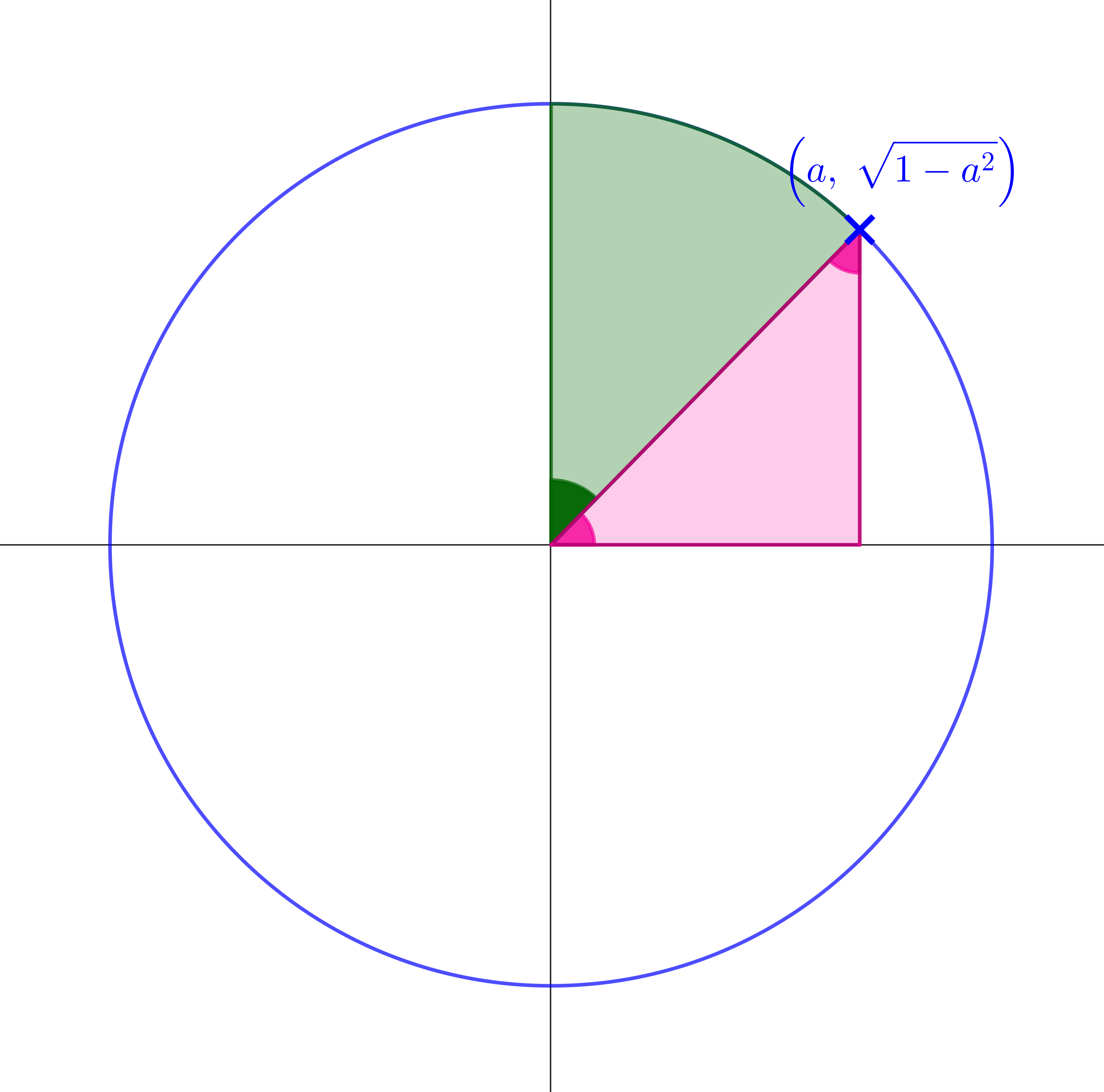
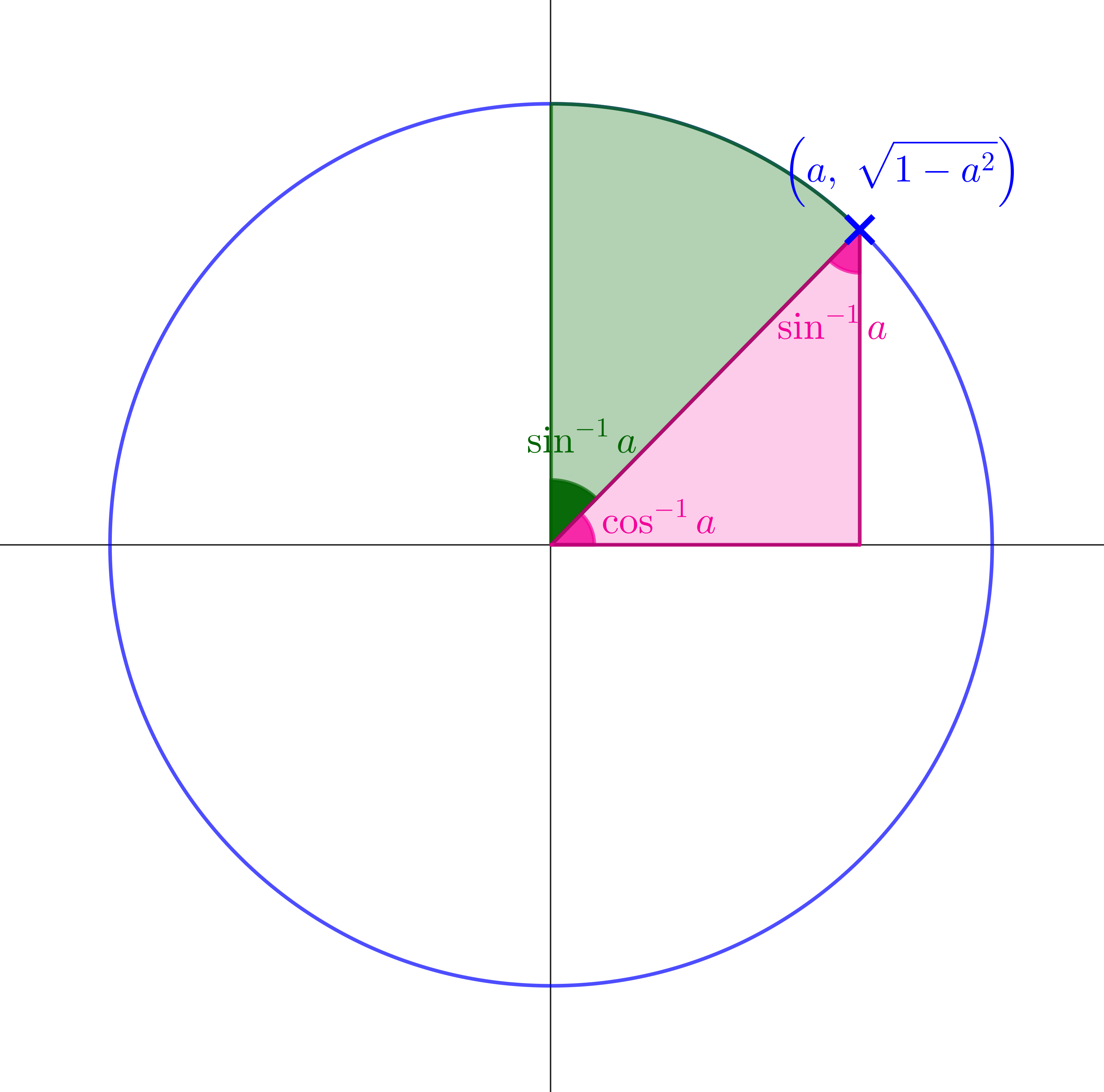
What are the marked angles, in terms of \(a\)?

integral

What are the area of the green segment and the area of the pink triangle?

\[\text{green area}=\frac{1}{2}\arcsin a\]
\[\text{pink area}=\frac{1}{2}a\sqrt{1-a^2}\]

Use these results to find \[\int_0^a\sqrt{1-x^2}\,\mathrm{d}x\]

\[\begin{aligned}\int_0^a\sqrt{1-x^2}\,\mathrm{d}x&=\text{green + pink areas}\end{aligned}\]
\[\begin{aligned}\phantom{\int_0^a\sqrt{1-x^2}\,\mathrm{d}x}&=\frac{1}{2}\arcsin a+\frac{1}{2}a\sqrt{1-a^2}\end{aligned}\]

Find \(\displaystyle{\int\sqrt{1-x^2}\,\mathrm{d}x}\) using the substitution \(\displaystyle{x = \sin u}\).

\[\frac{\mathrm{d}x}{\mathrm{d}u} = \cos u\]
\[\begin{aligned}\int\sqrt{1-x^2}\,\mathrm{d}x &= \int\sqrt{1-\sin^2 u}\cos u\,\mathrm{d}u\end{aligned}\]
\[\begin{aligned}\phantom{\int\sqrt{1-x^2}\,\mathrm{d}x} &= \int\cos^2 u\,\mathrm{d}u\end{aligned}\]
\[\begin{aligned}\phantom{\int\sqrt{1-x^2}\,\mathrm{d}x} &= \int\frac{1+\cos 2u}{2}\,\mathrm{d}u\end{aligned}\]
\[\begin{aligned}\phantom{\int\sqrt{1-x^2}\,\mathrm{d}x} &= \frac{u}{2} + \frac{\sin 2u}{4} + c\end{aligned}\]
\[\begin{aligned}\phantom{\int\sqrt{1-x^2}\,\mathrm{d}x} &= \frac{u}{2} + \frac{2\sin u\cos u}{4} + c\end{aligned}\]
\[\begin{aligned}\phantom{\int\sqrt{1-x^2}\,\mathrm{d}x} &= \frac{\arcsin x}{2} + \frac{x\sqrt{1-x^2}}{2} + c\end{aligned}\]

Well done on completing Part 3!

You have derived the derivatives of arcsin, arccos, and arctan, used them to evaluate integrals, and differentiated arcsin directly from the definition of the derivative.

Continue to Part 4 for integrals of inverse circular functions.

Dr Brian Brooks
Mathematics InSight

← Part 2Part 4 →